
By Chris Scheer, Co-Owner, Father Nature Landscapes
After two decades designing and building custom outdoor spaces across Tacoma and the South Sound, I’ve learned one truth about custom decks in Western Washington: The difference between a deck that thrives and one that fails comes down to smart material selection, proper drainage design, and construction quality that accounts for 40+ inches of annual rainfall. A professionally designed custom deck does more than add square footage—it creates a weatherproof gathering space, increases your property value by 70-80% of project cost, and solves the fundamental challenge every Tacoma homeowner faces: how to enjoy the outdoors despite nine months of moisture.
Table of Contents
Life+Land Lessons
✓ Multi-level deck designs maximize usable space on sloped properties common throughout the South Sound
✓ High-performance composite decking eliminates yearly staining and resists moisture damage
✓ Integrated built-in seating and planter boxes create defined outdoor zones
✓ Proper flashing and drainage systems prevent water intrusion at the house connection
✓ Stainless steel fasteners are non-negotiable in our wet climate to prevent rust staining and structural weakening
✓ Deck footings below the frost line (typically 18″ in Pierce County) ensure stability
✓ Strategic outdoor lighting extends deck functionality into our long winter evenings
✓ Rain catchment systems beneath decks transform runoff into irrigation for landscape beds
Choosing the Right Custom Deck Type for Your Tacoma Propert
Elevated Decks: The Solution for Sloped Tacoma Lots
Drive through North End neighborhoods or waterfront communities in Gig Harbor, and you’ll see dramatic elevation changes, hillside properties, and sloped yards that seem impossible to use. An elevated deck turns topographical liability into your best outdoor asset.
By building upward, we create level entertainment space above challenging grades. This requires engineered foundation support—typically 6×6 posts set in concrete footings that extend 18-24 inches below grade to prevent frost heave. The deck connects to your home through a properly flashed ledger board, the single most critical waterproofing detail in the entire project.
The space beneath an elevated deck isn’t wasted. We’ve transformed under-deck areas into dry storage, sheltered patio spaces with drainage systems, and even hot tub enclosures.
Multi-Tiered Deck Designs: Creating Distinct Outdoor Rooms
The most sophisticated custom decks use elevation changes to define separate functional zones without walls or barriers.
The upper tier connects to your kitchen door, hosting a built-in outdoor grill and dining area. Three steps down, the middle tier provides a conversation zone with built-in seating and a fire feature. Another level down, a lower platform creates a morning coffee spot nestled into garden plantings.
This tiered approach works beautifully on sloped Tacoma properties, but we also create level changes on flat lots purely for spatial definition. Each zone feels distinct yet connected—the outdoor equivalent of moving from kitchen to living room.
Vertical Integration: Maximizing Small Urban Lots
When horizontal space is limited, we build vertically. Vertical garden systems integrated into deck railings add greenery without sacrificing floor space. Privacy screens with living walls create enclosure while filtering street noise. Built-in planter boxes soften hard edges and bring color directly to the deck level.
Designing a Custom Deck That Defies Tacoma’s Wet Climate
Why Rot-Resistant Composite Decking Is the Only Realistic Choice
Let’s be direct: Traditional wood decking in Western Washington requires maintenance that most homeowners simply won’t do. Cedar needs yearly cleaning and resealing. Pressure-treated lumber grays, splinters, and develops surface mold. After three years of Tacoma’s moisture, untreated wood begins rotting from within.
Composite decking eliminates this cycle entirely.
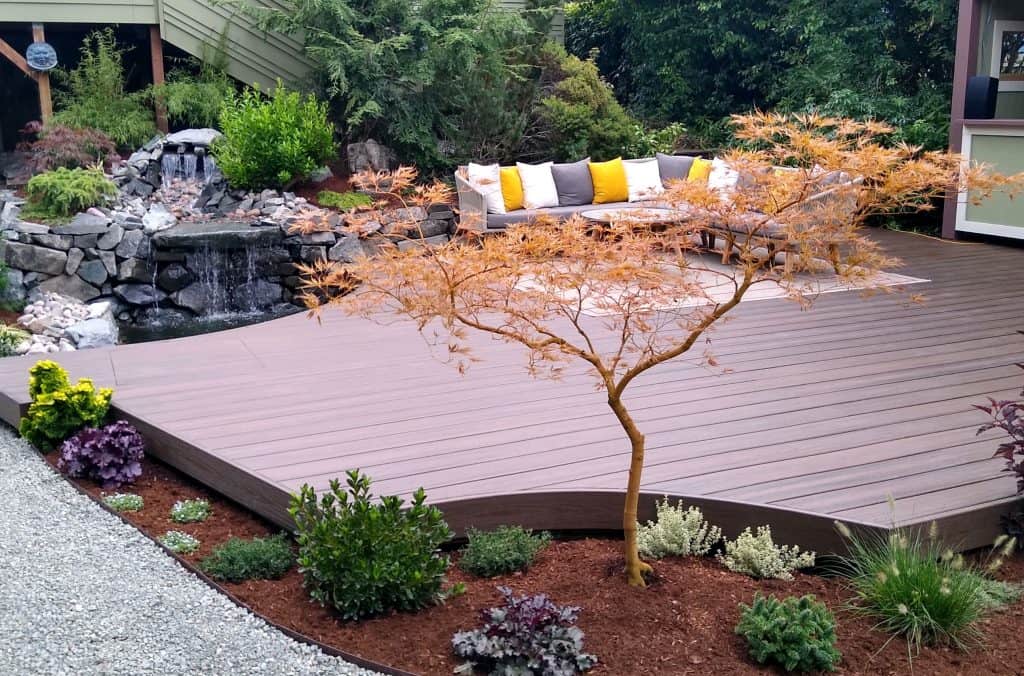
High-performance composite products—brands like Trex, TimberTech, and Fiberon—combine recycled wood fibers with protective polymer shells. The capped surface prevents moisture absorption while maintaining the aesthetic warmth of natural wood. You’re looking at 25-35 year lifespans with zero staining, zero sealing, and minimal cleaning.
The upfront cost runs 30-40% higher than wood. The breakeven happens in 5-7 years when you account for eliminated maintenance costs. More importantly, you actually use the deck instead of spending weekends maintaining it.
The Critical Importance of Drainage and Airflow
Trapped moisture is the silent killer of deck substructures. Even when the visible deck boards are composite, the framing underneath is still lumber. If water collects beneath the deck, that framing will rot.
Here’s how we design drainage systems that work:
- Board spacing: We maintain 1/4″ gaps between deck boards to allow water drainage and air circulation
- Grade slope: The ground beneath the deck must slope away from the house at minimum 2% grade
- Under-deck drainage systems: For elevated decks, we install ceiling systems that channel water into gutters, creating dry space below
- Strategic skirting: Perimeter skirting prevents animals from nesting underneath while incorporating ventilation gaps
Structural Design for Pacific Northwest Snow and Wind Loads
Pierce County building codes require decks to support 40 pounds per square foot (psf) live load plus 10 psf dead load. For covered decks, we design for an additional 25 psf snow load. This translates to:
- Deeper footings: 18-24 inches minimum depth, extending below the frost line
- Closer joist spacing: Typically 16″ on center for composite decking
- Reinforced lateral bracing: X-bracing or knee bracing prevents racking during windstorms
- Heavy-duty hardware: Joist hangers, post caps, and beam connections sized for calculated loads
Climate-Appropriate Color Selection
Lighter grays and multi-tonal browns are the most practical color choices for composite decking in our climate:
- They reflect solar heat on rare hot days, remaining comfortable for bare feet
- They naturally camouflage water spots, pine needle stains, and minor surface wear
- They complement the earthy, natural color palette common in Pacific Northwest architecture
Case Study: Transforming a Waterfront Deck in Gig Harbor
A homeowner contacted us after their 12-year-old cedar deck deteriorated beyond repair. The property sat 200 yards from the water—close enough for constant salt air exposure. The original deck showed advanced rot in the joists despite yearly staining. Hardware had corroded, leaving rust stains. The ledger board connection showed water damage extending into the house rim joist.
Our solution:
- Capped composite decking (Trex Transcend) with complete moisture resistance
- Stainless steel fasteners and hardware throughout—no galvanized steel in salt air
- Modified under-deck drainage system directing water away from the foundation
- Enhanced flashing details at the ledger board with peel-and-stick membrane plus metal flashing
- Integrated cable railing system to preserve water views
The result is a virtually maintenance-free deck designed for 30+ year lifespan in harsh coastal conditions. The homeowners went from spending weekends on maintenance to actually enjoying their waterfront property.
Creating Outdoor Rooms: Moving Beyond a Simple Platform
Built-In Seating and Integrated Planters
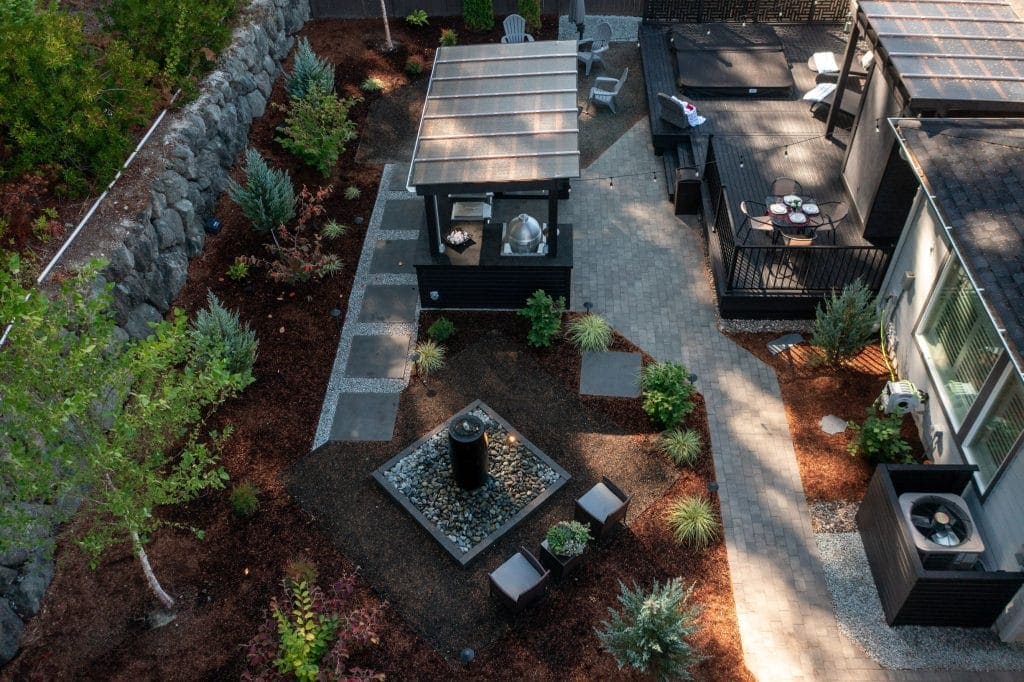
Built-in benches accomplish two things simultaneously: They provide permanent seating without cluttering the deck with furniture, and they define spatial boundaries that create room-like zones. An L-shaped bench in the corner creates an intimate conversation area. A long bench along the perimeter establishes the deck’s edge while providing seating for large gatherings.
Integrated planter boxes bring the landscape directly onto the deck level. We typically build these 18-24″ wide with drainage systems that prevent water from pooling. Filled with ornamental grasses, seasonal flowers, or small shrubs, these planters soften hard edges and create visual connections to the surrounding garden.
Creating Visual Focal Points with Deck Patterns
Thoughtful decking layouts transform the surface itself into a design feature:
- Contrasting borders: Running a different color composite along the perimeter to define the edge
- Diagonal or herringbone patterns: Laying boards at 45-degree angles for dynamic visual movement
- Inlay designs: Creating geometric patterns using multiple colors to designate zones
These patterns guide traffic flow and define areas. A contrasting inlay around the outdoor kitchen naturally designates that as the cooking zone.
Extending the Kitchen Outdoors
The most-used custom decks eliminate the barrier between indoor and outdoor cooking. We regularly design built-in grills with granite countertops, storage cabinets, and outdoor sinks connected to existing plumbing. This transforms meal preparation from an isolated activity into a social event.
The key is positioning outdoor kitchens directly adjacent to the interior kitchen door, creating seamless flow. We also incorporate weather protection—either a pergola overhead or positioning under an existing roof eave—so light rain doesn’t shut down the cooking space.
Selecting Low-Maintenance Materials That Last
The Real Cost Comparison: Composite vs. Wood Decking
Let’s break down actual long-term economics:
| Material | Cost/Sq Ft (Installed) | Annual Maintenance | Expected Lifespan | 20-Year Total Cost |
|---|---|---|---|---|
| Pressure-Treated Wood | $15-20 | $300-500 | 15-20 years | $11,000-15,000 |
| Composite (Trex, TimberTech) | $25-35 | $50-100 | 25-35 years | $8,000-10,000 |
Based on 400 sq ft deck
Higher upfront investment in composite decking delivers lower total ownership cost by eliminating maintenance cycles and extending replacement intervals.
Railing Systems: Balancing Views, Safety, and Durability
Cable railing systems are our most popular specification for properties with views. Horizontal stainless steel cables preserve sightlines while meeting 36″ height requirements. These systems resist corrosion and require minimal maintenance.
Glass panel railings offer completely unobstructed views but come at premium cost. The primary maintenance consideration: regular cleaning to prevent water spot buildup.
Composite or vinyl railings match the deck boards and offer good durability at moderate cost. We avoid wood railings—they require the same intensive maintenance cycle we’re trying to eliminate.
The Hidden Detail That Prevents Failure: Fastener Selection
Modern pressure-treated lumber contains copper-based preservatives that accelerate corrosion of standard galvanized hardware. Within 5-7 years, galvanized joist hangers and screws begin degrading, releasing rust that stains the deck and weakens structural connections.
We specify exclusively:
- Stainless steel screws and bolts for all structural connections
- Hot-dipped galvanized (G185) or stainless steel joist hangers
- Coated fasteners for composite decking to prevent surface staining
For coastal properties or areas with salt air exposure, stainless steel is non-negotiable throughout the entire structure.
Budgeting for Your Custom Deck Project: The Real Numbers
Cost Per Square Foot in the Tacoma Market
As of 2025, realistic installed costs for custom decks in the South Sound run:
- Basic pressure-treated wood deck: $18-25 per square foot
- Mid-grade composite deck: $28-38 per square foot
- Multi-level composite deck with built-ins: $45-65 per square foot
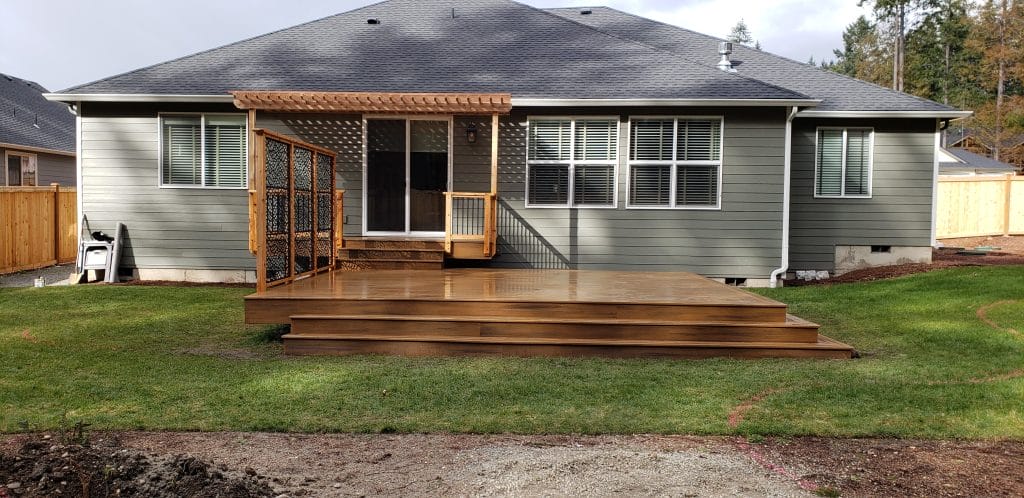
A typical 400 square foot composite deck with stairs, railing, and basic built-in benches runs $14,000-18,000 installed.
Hidden Costs That Catch Homeowners Off Guard
Permits and inspections: Pierce County requires permits for any deck over 200 square feet or more than 30″ above grade. Permit fees typically run $400-800, plus $200-500 for required inspections. Budget an additional $800-1,200 for structural engineer drawings if your deck exceeds certain heights.
Site preparation: Removing an old deck, clearing vegetation, or grading the building area adds $800-2,500.
Access challenges: Properties with difficult access can increase labor costs 15-25% due to hand-carrying materials.
Adding Value-Enhancing Features During Construction
It’s far more cost-effective to integrate these features during initial construction:
Landscape lighting: Low-voltage LED systems with deck post lights and stair lighting run $1,200-2,800 installed. They dramatically improve safety and extend usability into evening hours.
Outdoor kitchen rough-ins: Running gas lines, water lines, and electrical during deck construction costs $800-1,500. Adding them later often involves $2,500-4,000.
Return on Investment
Composite deck additions in the Seattle-Tacoma market recoup approximately 72% of cost at resale. A $20,000 composite deck typically adds $14,000-15,000 to home value.
But the real ROI includes increased marketability (homes with outdoor living spaces sell faster), lifestyle value you enjoy for years, and maintenance costs you avoid. Think of it this way: A quality composite deck delivers immediate daily use value while preserving 70-75% of the investment in resale value.
Building a Structurally Sound Deck Foundation
Footing Placement and Load Distribution
Deck footings must extend below the frost line—typically 18″ minimum depth in Pierce County, though some jurisdictions require 24″. This prevents frost heave, the expansion of frozen soil that can lift and crack shallow footings.
We dig footings 12-18 inches in diameter and pour concrete around a post base bracket. A 200 square foot elevated deck typically requires 6-8 footings positioned at maximum 8-foot spacing. Each footing must align directly under a post and beam connection.
Flashing the Ledger Board: The Most Critical Waterproofing Detail
The ledger board—where the deck attaches to your house—is the primary failure point in poorly built decks. Without proper flashing, water penetrates behind the ledger, soaking the house rim joist. Within 5-10 years, hidden rot develops inside the wall.
Our ledger board installation process:
- Remove siding to expose sheathing
- Install self-adhesive waterproofing membrane
- Bolt the ledger board to the rim joist using 1/2″ lag bolts per code
- Install metal flashing above the ledger to direct water over and away
- Leave 1/4″-1/2″ gap between ledger and house for drainage
This process takes 2-3 hours longer than simply screwing a board to the house. It’s also the difference between a deck that lasts 25 years and one that causes $15,000 in hidden structural damage.
Smart Features That Extend Deck Functionality
Landscape Lighting for Safety and Ambiance
We design lighting in layers:
Task lighting illuminates stairs, level changes, and cooking areas for safety. Ambient lighting creates soft glow that defines the deck’s boundaries and makes the space feel welcoming. Accent lighting uplights planters or nearby trees to create depth.
Modern low-voltage LED systems use less energy than a single incandescent bulb, often under $2-3 per month in electricity.
Rain Catchment and Eco-Friendly Water Management
We integrate rain catchment beneath decks. Gutters or under-deck drainage systems channel water into rain barrels or cisterns. A 400 square foot deck can collect 250 gallons of water from just one inch of rainfall—more than enough for drip irrigation through the dry season.
Integrated Fire Features for Year-Round Use
Built-in gas fire pits or fire tables provide warmth and gathering focus without smoke, sparks, and ash. We typically position these on a lower deck level to create an intimate zone.
A fire feature extends comfortable deck use from May-September into year-round outdoor living for hardy Pacific Northwesterners willing to embrace cool temperatures.
Four Critical Mistakes That Destroy Deck Projects
1. Not Verifying Local Building Codes and Permit Requirements
Assuming you know the rules—or deliberately avoiding permits—leads to costly consequences:
- You’re legally required to disclose unpermitted work when selling
- Buyers can demand removal or request price reductions
- Homeowner’s insurance may deny claims related to unpermitted structures
- You carry liability risk if someone is injured on a non-code-compliant deck
The right process: Before design begins, verify with your local building department what permits are required. In Pierce County, most decks over 200 square feet require permits. The peace of mind is worth the $600-900 in fees.
2. Using Incorrect Fasteners for Pressure-Treated Lumber
Modern pressure-treated lumber uses copper-based preservatives that actively corrode standard galvanized hardware. I’ve inspected 8-year-old decks where joist hangers were literally disintegrating.
The solution: Specify stainless steel or hot-dipped galvanized G185-rated hardware exclusively. This fastener upgrade adds approximately $300-600 to an average deck project—a rounding error compared to the structural integrity it preserves.
3. Inadequate or Improperly Placed Footings
Common footing mistakes include insufficient depth, too small diameter, improper spacing, and post bases sitting directly on dirt instead of concrete. These aren’t minor issues—they’re complete rebuilds.
Proper footings cost $150-250 each installed. An average deck needs 6-10 footings. This $1,200-2,000 investment is the literal foundation of the project.
4. Blocking Basement Window Egress
Building codes require unobstructed egress (emergency exit) from all basement windows. Decks cannot block this escape route.
Identify all egress windows before finalizing deck layout. Design either maintains clear distance or incorporates a step-down well that provides unobstructed exit. Inspectors will not issue permits for designs that block egress.
Frequently Asked Questions
Q: What are the real advantages of composite decking over wood in Western Washington?
Composite decking eliminates the maintenance cycle that wood requires in our wet climate. Cedar and pressure-treated lumber need yearly cleaning and sealing to prevent rot, mold, and insect damage. Capped composite decking resists moisture absorption completely. Clean it once or twice a year with a hose. No staining. No sealing. No splinters. The material lasts 25-35 years versus 15-20 for well-maintained wood.
Q: How can I add weather protection to make the deck usable year-round?
The most effective weather protection comes from overhead coverage—either extending your existing roof eave or adding a dedicated structure. Roof extensions work beautifully when the deck is adjacent to the house. For standalone coverage, we design custom pergolas with optional polycarbonate panels or retractable fabric canopies.
Q: Why is checking building codes so important?
Building codes vary by jurisdiction and update regularly. Pierce County requirements differ from Tacoma City regulations. Even experienced builders must verify current codes for each project’s specific location. Beyond code compliance, permit reviews catch design flaws early. The inspector reviewing your plans might identify a structural concern that would have become a much bigger problem during construction.
Q: What’s the best approach for integrating a deck with a sloped property?
We typically create tiered decks that step down the slope, following the natural grade. This approach minimizes the height of any single level while creating distinct functional zones. Each level feels purposeful because it corresponds to the topography. For severe slopes, we sometimes combine upper deck levels with lower hardscape patios.
Creating a Custom Deck That Expands How You Live
A well-designed deck fundamentally changes how you experience your home. It creates space for weeknight family dinners outdoors. It provides a platform for Saturday morning coffee while watching the sunrise over Mount Rainier. It becomes the gathering place where friends naturally congregate.
The difference between a deck that delivers this lifestyle value and one that becomes a maintenance burden comes down to smart design decisions and quality construction.
At Father Nature Landscapes, we’ve spent two decades creating outdoor living spaces across Tacoma and the South Sound. We understand the unique challenges of building in Western Washington’s climate, and we’re committed to construction quality that delivers decades of use with minimal maintenance.
Your outdoor space has potential you’re not currently accessing. Let’s explore what’s possible for your property.
This guide reflects building practices and code requirements current as of 2025 in Pierce County, Washington. Always verify current local building codes and permit requirements with your jurisdiction before beginning construction.