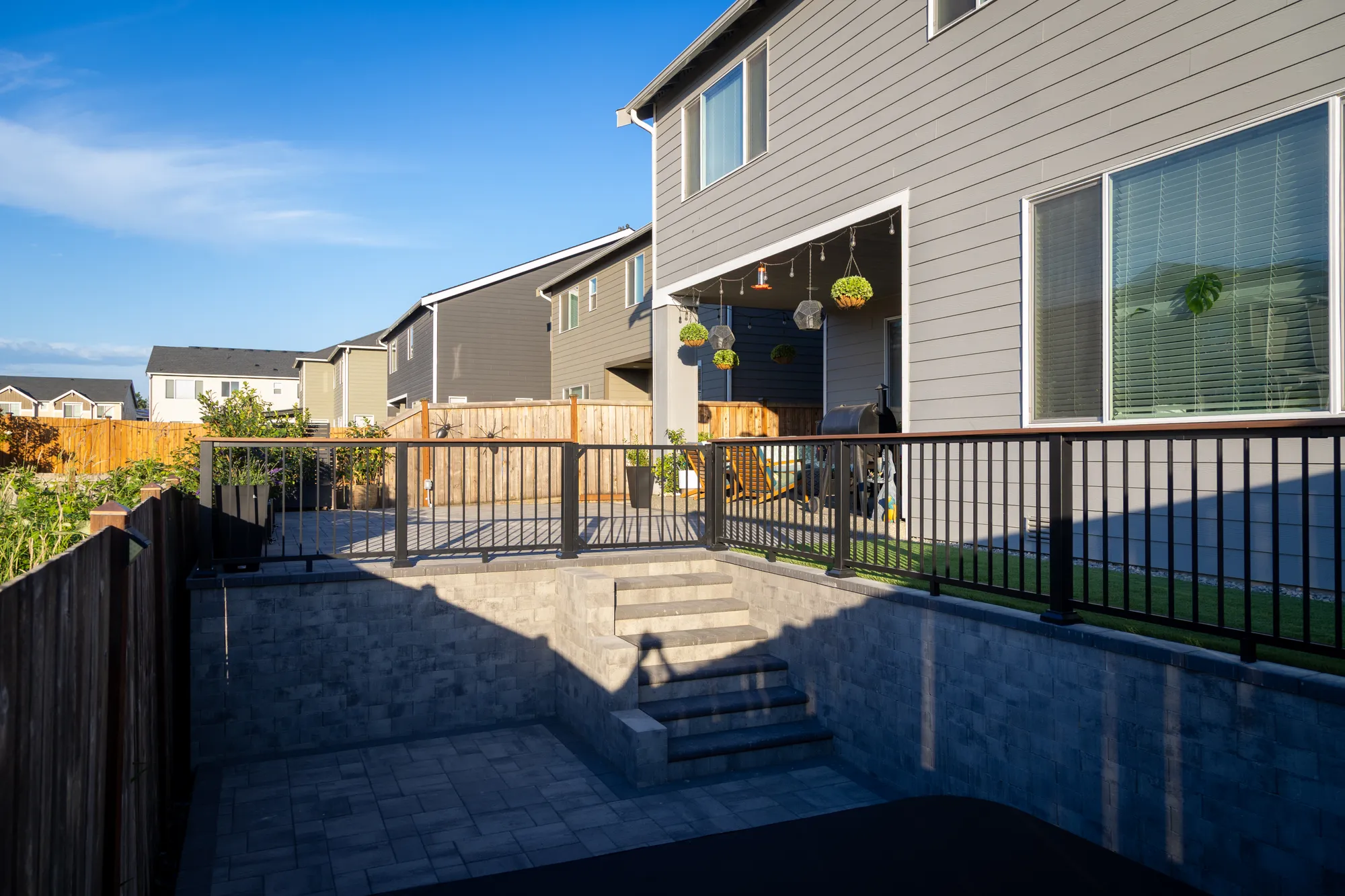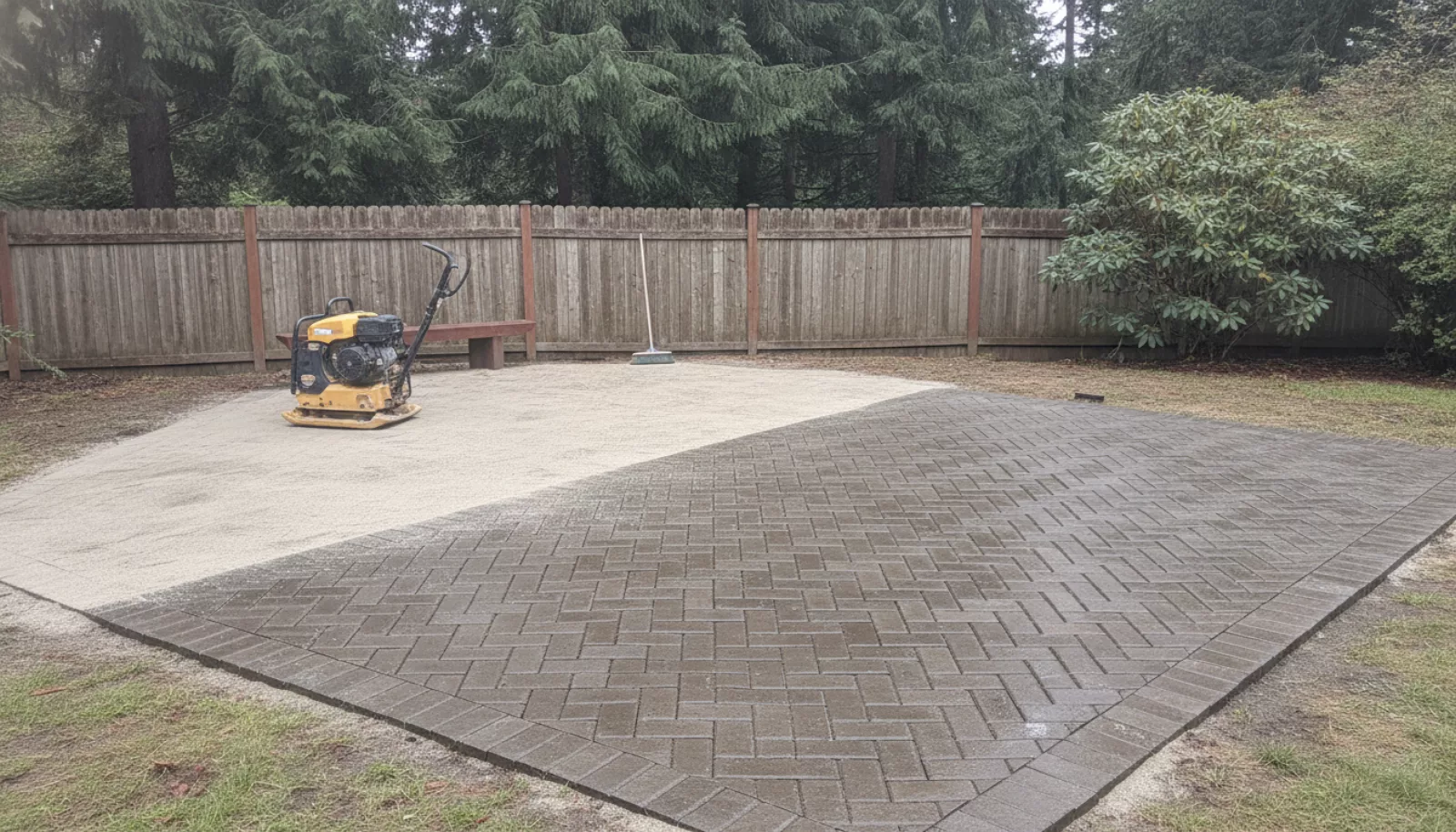
A concrete paver is a manufactured unit held to a published strength and absorption standard, which makes it one of the few things in your yard that arrives already proven. Concrete pavers in Tacoma almost never fail because of the paver. After 20 years of installs across Tacoma, Gig Harbor and Puyallup, I can count on one hand the times I’ve been called out to a patio where the units themselves were the problem.
What fails is the base and the water. Usually it’s a base that went in too shallow, or got compacted by eye instead of to a standard, or sat on a subgrade that stays wet from November through April.
So this guide is about the parts you can’t see once the job is finished. It covers what the standard actually pins down, how deep the stone under your patio should be, what Washington and the City of Tacoma say about hard surface, and how to read a bid closely enough to tell a crew that plans to dig from a crew that plans to be gone by Thursday.
Nine things, in the order they tend to matter.
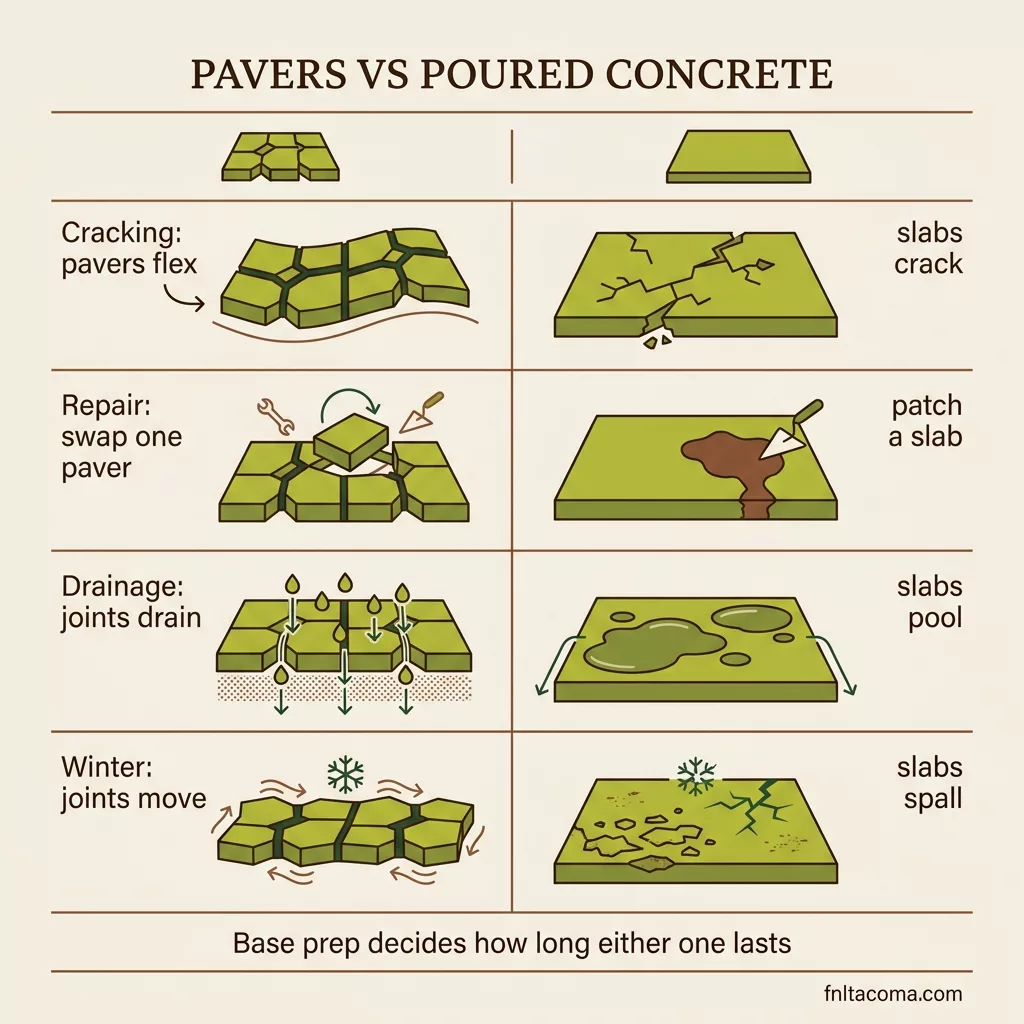
Concrete Pavers vs Poured Concrete, Side by Side
Both surfaces work in this climate when they’re built right, and both fail in the same wet ground when they aren’t. The difference is what happens after something moves.
Pavers here are dry-set. They sit on compacted stone and bedding sand with no mortar, which is why the assembly underneath does the structural work.
| Factor | Concrete pavers | Poured concrete |
|---|---|---|
| Ground movement | Individual units shift slightly on a flexible base | One rigid plane that cracks where it can’t flex |
| Repair | Lift the affected units, fix the base, reset them | Patch, resurface, or tear out and repour |
| Drainage | Standard or permeable assemblies available | Surface runoff, directed by slope and drains |
| Design range | Patterns, borders, color changes, resettable | Uniform pour; stamping mimics a pattern permanently |
| Install speed | Slower, because most of the schedule is base work | Faster to place, then a cure window before use |
| Upfront cost posture | Higher on day one for the same square footage | Lower on day one for the same square footage |
Quick takeaways:
- Pavers move with the ground. A slab has to resist it.
- Repairs happen at the unit level on pavers and across the whole surface on a slab.
- Permeable assemblies only exist on the paver side.
- Concrete goes in faster, which matters when our weather windows are short.
- The cheaper day-one number belongs to concrete, and that is a real advantage on a large flat pad.
I’ve written the full head-to-head elsewhere, so read the pavers vs concrete patio comparison if you want the long version. The rest of this guide is about the material and the spec.
1. A Concrete Paver Is a Specification, Not a Shape
A paving unit built to ASTM C936 has to hit an average compressive strength of 8,000 psi with no single unit below 7,200 psi, which is the number the Concrete Masonry and Hardscapes Association guide specification puts in writing. Absorption is capped in the same document at 5% on average, with no unit allowed above 7%.
Thickness has a floor too. The minimum concrete paver thickness under the standard is 2 3/8 inches, or 60 millimeters, which is thicker than most of what you’ll find stacked outside a home center.
Four things the standard actually pins down:
- Average compressive strength of 8,000 psi across the sample
- A hard floor of 7,200 psi for any individual unit
- Average water absorption of 5%, with 7% as the ceiling for a single unit
- A minimum unit thickness of 2 3/8 inches
The thin square patio blocks sold in garden centers look close enough at a glance, and they are a different product. They’re molded for a homeowner setting a few stepping stones on grade, and they don’t carry the strength or absorption testing.
This is worth one question to whoever is bidding your job. Ask which unit they’re specifying and ask for the manufacturer’s spec sheet. The answer is one line on that sheet, and a supplier who sells to contractors will have it in about ten seconds. If nobody can produce it, you’ve learned something.
2. The Base Under the Paver Decides Whether It Lasts
Almost every failed paver surface I’ve been called out to in the South Sound failed below the paver. The stone under the units was thin, or wet, or never properly compacted.
The industry application guide, ICPI/CMHA Tech Spec 10, is specific about all three, and its aggregate base, compaction and bedding sand figures are what you hold a bid up against:
- Aggregate base: 4 to 6 inches under a walkway, 6 to 8 inches under a residential driveway
- Compaction: at least 98% Proctor density per ASTM D698 for pedestrian areas and residential driveways
- Compaction under constant vehicle traffic: at least 98% modified Proctor per ASTM D1557
- Bedding sand: screeded 1 to 1 1/2 inches uncompacted, graded to ASTM C33, and never mason sand
That 98% figure matters because 95% is the number repeated across contractor content. A crew that knows the difference will tell you which one they’re hitting and how they check it.
A couple in their late fifties out toward Fircrest called me about a two-year-old patio that had dished in the low corner near their downspout. We pulled a section and found roughly 3 inches of unwashed fill sitting straight on clay, no separation fabric, and the fines had migrated into the subgrade until that corner sat lower than the rest. The pavers were perfectly good. Everything under them had to come out.
Nobody photographs this part of the job. The work is excavation, hauling, grading, compacting in lifts, checking that compaction, and screeding the bedding course. It eats most of the schedule and none of it ends up on a project page, which is why it’s the first thing thinned out of a low bid.
3. Standing Water Does More Damage Here Than Freeze-Thaw
Tacoma does not have a freeze-thaw climate in the way the industry literature assumes. NOAA’s 1991 to 2020 normals for the Tacoma Number 1 station show 27.2 days a year where the low reaches 32 degrees or below, against 40.81 inches of annual precipitation. That station sits about four miles from our shop, so it reads the yards we work in.
The laboratory freeze-thaw test behind the paver standard is ASTM C1645:
- 28 freeze-thaw cycles with no more than 225 grams per square meter of surface loss
- Or 49 cycles with no more than 500 grams per square meter
- Tested to minus 15 degrees Celsius, immersed in a 3% saline solution where the pavement will see deicers
- Waived entirely for units that will not be exposed to freezing conditions
Those are laboratory cycles run on a single unit, and the test method itself says its results are not intended to measure length of service. Freeze-thaw ratings still get quoted at homeowners as though they were a warranty on the whole assembly.
What actually goes wrong in a South Sound winter:
- A subgrade that stays saturated from November through April and loses bearing strength
- Fines washing out of an under-specified base and taking support with them
- Roof and downspout water discharging onto or under the pavement instead of past it
- Joint sand washing out at the low edge where sheet flow concentrates
- Moss and needle litter holding moisture on the surface all winter
Every one of those is a drainage question. If water already runs toward your house or stands on the lawn in February, read how we handle water on a wet South Sound lot before you pick a paving material.
4. Permeable Pavers Are a Drainage System, and Washington Treats Them Like One
Permeable pavers are a stormwater structure with a paved top. An open-graded stone reservoir sits under the units and holds water while it infiltrates, and the joints are filled with clean angular stone rather than sand so water can reach it.
The state treats them accordingly. Washington’s Department of Ecology carries permeable pavement as BMP T5.15 in Volume V of the 2024 Stormwater Management Manual for Western Washington, the volume covering runoff treatment, flow control and low impact development.
The manual is Publication No. 24-10-013, and it carries an honest limit worth knowing before anyone sells you on the environmental angle. Ecology does not offer a runoff treatment credit for stormwater passing through a standard permeable pavement wearing course or the aggregate base, so the credit these assemblies earn is for flow control.
Where permeable earns its keep on a South Sound lot:
- Water sheets toward the house and there’s nowhere obvious to send it
- A driveway that dumps straight into the street or a neighbor’s yard
- A flat lot on slow Pierce County clay where surface drainage has no fall to work with
Where it doesn’t:
- A site that carries heavy sediment, bark, or soil wash onto the pavement
- A slope that needs water conveyed somewhere specific instead of infiltrated in place
- A subgrade that can’t infiltrate, where you’d be building a reservoir with nowhere to drain
The joints have to be kept clear of the silt and organic debris a wet climate delivers, because a clogged joint stops infiltrating and leaves you with an expensive standard pavement.
5. In Tacoma, the Permit Question Turns on 2,000 Square Feet
For a single-family home in Tacoma, sidewalks and driveways sit on the city’s list of work exempt from a building permit, and the city adds a note in the same line that a separate site development permit may still be required. The building permit question and the site development question are two different questions.
The site development thresholds are the ones to check:
- New or replaced hard surface of 2,000 square feet or more
- Any project that disturbs 7,000 square feet or more of land
- Grading or filling more than 50 cubic yards of material
Read that practically. A 400-square-foot back patio is nowhere near the line. A driveway replacement plus a patio plus a connecting walkway on the same project can cross it, because hard surface is cumulative across the work, not measured one element at a time. The 7,000-square-foot disturbance figure catches projects that look small on paper and involve a lot of ground.
These are Tacoma’s thresholds. Gig Harbor, Puyallup, University Place and unincorporated Pierce County each set their own, so the number that governs your project is the one for the jurisdiction your parcel actually sits in.
The permit line item is exactly what a low bid leaves out. I’ve seen homeowners find out mid-project that the scope crossed a threshold nobody checked, and the conversation that follows is never a good one. Ask any bidder in writing whether the project triggers a site development permit and who is responsible for filing it.
6. A Patio, a Walkway, and a Driveway Are Three Different Builds
The pavers can be identical across all three and the assembly underneath is not. A patio built to a walkway spec will hold up fine until somebody parks a truck on it.
| Application | Aggregate base | Compaction standard | Edge restraint demand | What fails first |
|---|---|---|---|---|
| Walkway | 4 to 6 inches | 98% Proctor (ASTM D698) | Moderate, both long edges | Edges spreading, joint sand washout |
| Patio (pedestrian) | 4 to 6 inches | 98% Proctor (ASTM D698) | Moderate, higher at open edges | Settling at low corners and downspouts |
| Residential driveway | 6 to 8 inches | 98% Proctor (ASTM D698) | High, especially at the apron and turns | Rutting in wheel paths, apron movement |
| Any surface under constant vehicle traffic | Engineered per use | 98% modified Proctor (ASTM D1557) | High | Base deformation under repeated loading |
A patio gets built to the pedestrian standard unless it will carry a vehicle. If there’s any chance a trailer, a boat, or a delivery truck crosses it, say so before the base goes in, because changing your mind afterward means excavating what’s already there.
The 2 3/8 inch thickness minimum is a floor. On vehicular work, unit thickness and the interlock pattern start doing structural work, and a herringbone laid at the right angle to traffic behaves very differently from a running bond.
Cost is a separate conversation with its own numbers. If you’re pricing a project, read what a paver patio costs in Tacoma or what a paver driveway costs here.
7. The White Haze Is Efflorescence, and It Goes Away on Its Own
That chalky white film on a new paver surface is efflorescence, and it is normal. It forms when Portland cement reacts with water to create water-soluble calcium hydroxide that migrates to the surface, and the industry maintenance guide describes it as an aesthetic concern rather than a structural one. The appearance stops once the calcium hydroxide supply is used up.
I get this call about three weeks after an install, usually from someone convinced the pavers were defective or the batch was bad. The honest answer is to wait. Cleaners exist, and most of the time they treat a symptom that was going to resolve anyway.
The maintenance that actually matters:
- Joint sand: top it up where it washes out, particularly at edges and low points after a hard winter
- Moss and needle litter: sweep and clear it in a wet climate, because it holds moisture and stains
- Weeds: they germinate in surface debris in the joints, so keeping joints clean beats spraying
- Sealing: optional, useful against staining and color fade, and not a requirement for the surface to perform
- Stains: deal with them early, before they set into the unit
Oil is the one stain worth handling promptly instead of waiting to see whether it fades.
8. Pavers Get Repaired. Slabs Get Replaced.
The repair difference is documented. With an interlocking concrete pavement, a utility cut can be reinstated without damage to the pavement surface, and the units that came out go back down instead of into a landfill. The same guide notes that these pavements stiffen and increase their structural capacity as they receive traffic, which runs opposite to how most people assume a paved surface ages.
Now the part where I disagree with my own industry. You’ve probably seen the lifespan comparison that gets passed around, where pavers last decades longer than a poured slab. I went looking for the source of those figures across the standards bodies, the industry institutes and the transportation agencies, and I cannot find one. Contractor sites quote wildly different ranges for the same product and none of them cite anything, so I won’t quote you a number I can’t show you.
What is documented is the repair behavior and the load behavior above. That’s the honest case for pavers, and it holds up without a made-up number.
What a unit-level repair actually looks like on a job:
- Lift the affected units with extraction tools, keeping them intact for reuse
- Open the bedding course and diagnose what moved, whether a root, a washout, or thin base
- Correct the cause, which sometimes means rebuilding the base in that area
- Re-screed bedding sand to a consistent uncompacted thickness
- Reset the original units, refill the joints, compact
- Expect some color difference for a season while the reset units weather back in
9. Where Paver Work Belongs in a Real Project, and When We Are the Wrong Call
At Father Nature, paver work is almost never the whole project. It’s the floor of an outdoor living space that also carries grading, drainage, lighting, planting and usually a structure, and each of those moves where the hard surface goes. So it gets drawn before it gets built, in a conceptual landscape design that settles drainage and elevations on paper instead of in the dirt.
Our full outdoor living projects start at $50,000, and the paver surface is one line inside it.
Our project floor is $50,000. If what you want is a 60-foot front walkway on its own, we are the wrong firm for it, and a dedicated paver specialist will serve you better and finish it faster. I’d rather tell you that now than take the job and have both of us regret it.
The work starts the same way every time:
- Either I walk your property or Cameron does, looking at the grade, the drainage, the access and how you use the space
- You get an initial written estimate from it
- Then we bill time and materials, so you pay for the hours and materials the job actually takes instead of a padded guess
Father Nature Landscapes has been building outdoor spaces across Tacoma, Gig Harbor, Puyallup and University Place since 2006. We carry more than 200 five-star reviews across Google, Yelp and Angie’s List, an A-plus rating with the Better Business Bureau, and a feature on HGTV. Washington contractor license FATHENL922JT. Father Nature leads the design, and our build and maintenance crews are our own people, so the base and drainage details never get handed off.
If you want a straight read on your yard, set up a site walk or call us at 253-761-6437.
The Bottom Line
The paver itself is the most standardized part of your project and the least likely thing to go wrong. What decides the outcome is the depth and compaction of the stone underneath it and where the water goes in February. The local rules worth knowing are Ecology’s stormwater manual, which governs permeable assemblies, and Tacoma’s 2,000-square-foot hard surface threshold, which decides whether your project needs a site development permit.
So judge the bids on three things before you compare the prices:
- Inches of aggregate base under the surface
- The compaction standard the crew is hitting, and how they check it
- The bedding sand spec, including the grading it’s held to
A bid that only says “install pavers” gives you nothing to compare, and a bidder who won’t put those three numbers in writing is telling you something about how the job will get built.
Take the next bid you receive and ask for those three numbers in writing. If you’d rather have someone walk the property with you first, get in touch and we’ll take a look at your grade, your drainage and what you’re actually trying to build.
Frequently Asked Questions
Are concrete pavers a good choice for Tacoma’s rainy climate?
Yes, and the reason is the flexible base rather than the paver. Individual units sitting on compacted stone and bedding sand accommodate the seasonal ground movement that a rigid slab has to resist. The catch is that our wet ground makes base depth, compaction and drainage design more important here than in a drier climate.
Do I need a permit for a paver patio in Tacoma?
Usually not a building permit. Sidewalks and driveways are on Tacoma’s list of work exempt from a building permit for a single-family home. A separate site development permit applies once a project adds or replaces 2,000 square feet or more of hard surface, disturbs 7,000 square feet or more of land, or moves more than 50 cubic yards. See section 5 above for how the thresholds stack.
How thick should the base be under a paver driveway?
The industry application guide calls for 6 to 8 inches of aggregate base under a residential driveway, compacted to at least 98% Proctor density, against 4 to 6 inches for a walkway. Soil conditions can push that deeper. Pierce County clay and a saturated subgrade both argue for more base, and a good contractor will tell you why on your lot.
Why do my new pavers look white or chalky?
That’s efflorescence, and it resolves on its own. Portland cement reacting with water produces water-soluble calcium hydroxide that travels to the surface and dries as a white film. It’s cosmetic, and it stops once the supply is exhausted. Section 7 covers what to do in the meantime, which is mostly nothing.
Are permeable pavers worth it in the South Sound?
They’re worth it when the site has a water problem. A lot that sheets toward the house, a driveway that dumps into the street, or a flat parcel on slow clay are all cases where an open-graded reservoir under the pavement does real work. Washington’s Department of Ecology credits permeable pavement for flow control rather than runoff treatment, so the case rests on where water goes.
Sources
- CMHA Guide Specification PAV-GSP-010-21, Pavers on a Mortar Bed
- ASTM C936, Standard Specification for Solid Concrete Interlocking Paving Units
- ICPI/CMHA Tech Spec 10, Application Guide for Interlocking Concrete Pavements
- ASTM C1645, Freeze-thaw and De-icing Salt Durability of Solid Concrete Interlocking Paving Units
- CMHA Operation and Maintenance Guide for Interlocking Concrete Pavement, PAV-TEC-006
- Washington State Department of Ecology, 2024 Stormwater Management Manual for Western Washington
- City of Tacoma, What Requires a Permit tip sheet
- NOAA NCEI, 1991-2020 U.S. Climate Normals, station USC00458278 Tacoma #1