You finally have a picture of the yard you want. A covered patio you’d actually use in February, a place for the fire pit, the planting that looks good from the kitchen window. Then you look out at the corner that’s been a puddle since October and wonder whether reality will hold up to your vision.
It can. I’ve been building outdoor spaces in Tacoma since 2006, and I’ll be honest, I really enjoy fixing water problems on a property. It’s not a perfect science, but there’s a lot we can do, even when the problems seem impossible. The catch is that every fix does one specific job, and a fix chosen for the wrong job just moves the water somewhere else. Here’s what each one does, and how they come together when a yard gets renovated.
Life+Land Lessons
- NOAA’s Tacoma #1 station has a normal of 40.81 inches of rain a year, and about 76 percent of it falls from October through March, when nothing dries out.
- Much of Tacoma sits on Alderwood soils that turn very slowly permeable a few feet down, so rain soaks in and then has nowhere to go.
- Fix the roof water and the grade along the house first. Most of the other fixes only work once those two are right.
- A French drain handles water moving through the ground. A surface drain handles water sitting on top. They aren’t interchangeable.
- In a renovation, drainage is designed with the patio, walls and planting, because those decide where the water goes.
Why Tacoma Yards Hold Water
Three things keep the water in your yard: when the rain falls, what sits under the lawn, and what’s been built on top. Most of our rain comes in the months when the ground never dries, with November averaging 6.50 inches at the Tacoma station. The City of Tacoma’s environmental review describes soils in the city as a mix of fast-draining Everett soils and Alderwood soils, which sit on a dense layer about three feet down that barely lets water through. That’s how your yard can hold water while the one down the street drains fine. Then come the roofs, patios and raised beds that send water where it doesn’t belong. Our guide to diagnosing backyard drainage problems goes through the signs and causes in detail, so here I’ll stick to the fixes.
Start With the Roof Water and the Grade
Downspout lines
A roof collects a surprising amount of water, and a downspout that empties onto the lawn dumps all of it in one spot right next to the house. The secret fix is to connect the downspouts to solid pipe buried in the ground and carry the water away to an outlet that can take it.
Here’s a job that shows how it usually goes. The downspouts on one house were just emptying into the yard, and the water was saturating the basement because it never got a chance to get away from the home. The ground made it worse, sloping back toward the house. We ran four-inch pipe around the house, tied every downspout into it, and piped the water off the property. Then, with the pipe in the ground, we regraded the lot a little so the house became the high spot.
Regrading
Regrading means reshaping the ground so water runs away from the house instead of toward it. Washington adopts the 2021 International Residential Code, and section R401.3 asks for the ground to fall at least 6 inches within the first 10 feet of the foundation, with hard surfaces in that zone sloping at least 2 percent away from the building. Where a property line or a wall makes that much fall impossible, the code calls for drains or swales to carry the water away instead.
In a renovation, the grade at the house is the first height we set, because every patio, step and bed steps down from it. It’s also where hidden damage turns up. On one job we removed an old concrete patio with steps into the house in three places, and found a lot of water had been getting past those steps. The previous installer had put no flashing against the house, so water had been trapped behind the concrete against the sheathing. We repaired the rot, then installed window-and-door style flashing and a metal drip edge over the new entries before anything new went down.
One honest limit. If water is coming through a basement wall, that’s a question for a foundation specialist, not a landscape company.
French Drains: For Water Moving Through the Ground
A French drain is a trench lined with fabric, filled with clean, free-draining gravel, with a perforated pipe in the bottom. Water moving through the soil finds the gravel, drops into the pipe and runs to an outlet.
That makes it the right tool for ground that stays soggy because water is seeping through it, often from a slope above or from water perched over that dense layer. It’s the wrong tool for a puddle on top of compacted soil or a patio, because that water never gets down to the pipe.
Three things decide whether one works. It has to sit across the path the water takes, such as at the foot of a slope or between a hillside and the house. It has to end at an outlet that can take the water, because a pipe that empties into the next low spot or toward the neighbor’s yard just moves the problem. And it has to be built with the fabric and gravel that keep fine soil out of the pipe, or it slowly fills with silt and quits.
Surface Drains: For Water Sitting on Top
Catch basins and area drains
A catch basin is a box set at a low point with a grate on top. Surface water pours in and leaves through a solid pipe. It’s the fix for a low spot in a lawn or a bed where water collects and sits.
Channel drains
A channel drain, sometimes called a trench drain, is a long, narrow grated channel set into a hard surface. It catches water running across a patio, driveway or walk before it reaches the house or the lawn. On a new patio, the better answer is usually to pitch the surface correctly in the first place and use a channel only where the layout can’t.
Dry wells
A dry well is a buried chamber or gravel pit that holds collected water and lets it soak slowly into the ground. It only works where the soil below can take the water. On Alderwood ground with that dense layer a few feet down, that isn’t a given, so it’s one to check on your site rather than assume.
Swales and Dry Creek Beds: Moving Water in the Open
A swale is a shallow, gently sloped channel in the ground that carries water across or around a yard. A dry creek bed does the same job lined with river rock, and it looks like part of the landscape all summer. On a sloped yard, these often work alongside walls and steps. One client described what we built on their slope: “We had a steep, untamed slope in front of our house. Father Nature was able to turn my idea of 3-4 retaining walls and stone steps into reality; creating a very visual appealing hillside, while also strengthening it to help prevent erosion concerns.” Our posts on retaining walls for sloped yards and how Pacific Northwest slopes behave go deeper on that.
Rain Gardens and Permeable Paving: Handling Water Where It Falls
Rain gardens
A rain garden is a shallow planted bed that collects runoff from a roof or a patio and lets it soak in over a day or two. Done right, it turns water you’d otherwise pipe away into planting you get to enjoy from the kitchen window. Siting is everything. The Department of Ecology’s rain garden handbook for Western Washington says not to put one in a low spot that doesn’t drain well, within 10 feet of a foundation, or where winter groundwater rises within a foot of its bottom. That rules out a lot of the soggy corners people want to put one in, which is exactly why it gets placed in the design and not dug where the puddle is.
Permeable paving
Permeable pavers let rain pass through the joints into a deep stone base, instead of shedding it toward the lawn or the house. On fast-draining ground, the base can let the water soak away. On slow-draining ground, the base still needs a way to send the extra water somewhere, so it’s designed with the rest of the drainage.
Why Drainage Belongs Inside the Renovation Plan
Most people these days ask me about a covered patio or a fire pit, and fixing the drainage comes along with it. In a renovation, the drainage decisions and the layout decisions are the same decisions. Where the patio sits, how high it is and which way it pitches decide where the water goes. So the design settles all of it together:
- The finished grade along the house, set before anyone picks a patio height.
- Which way each hard surface sheds, and where that water lands.
- Walls on a slope, with their own drainage behind them.
- Planting chosen for ground that stays wet, instead of a lawn that fights it every winter.
- One outlet for the whole yard, so every downspout, drain and surface sends water somewhere that can take it.
The city has rules here too. Under Tacoma’s July 2026 stormwater manual, a project with 2,000 square feet or more of new plus replaced hard surface has to meet the city’s stormwater requirements, and patios, walks and roofs all count toward that number. Connecting a private drainage system to the city’s storm network also needs a city permit. We work those into the design so nobody finds out halfway through the build.
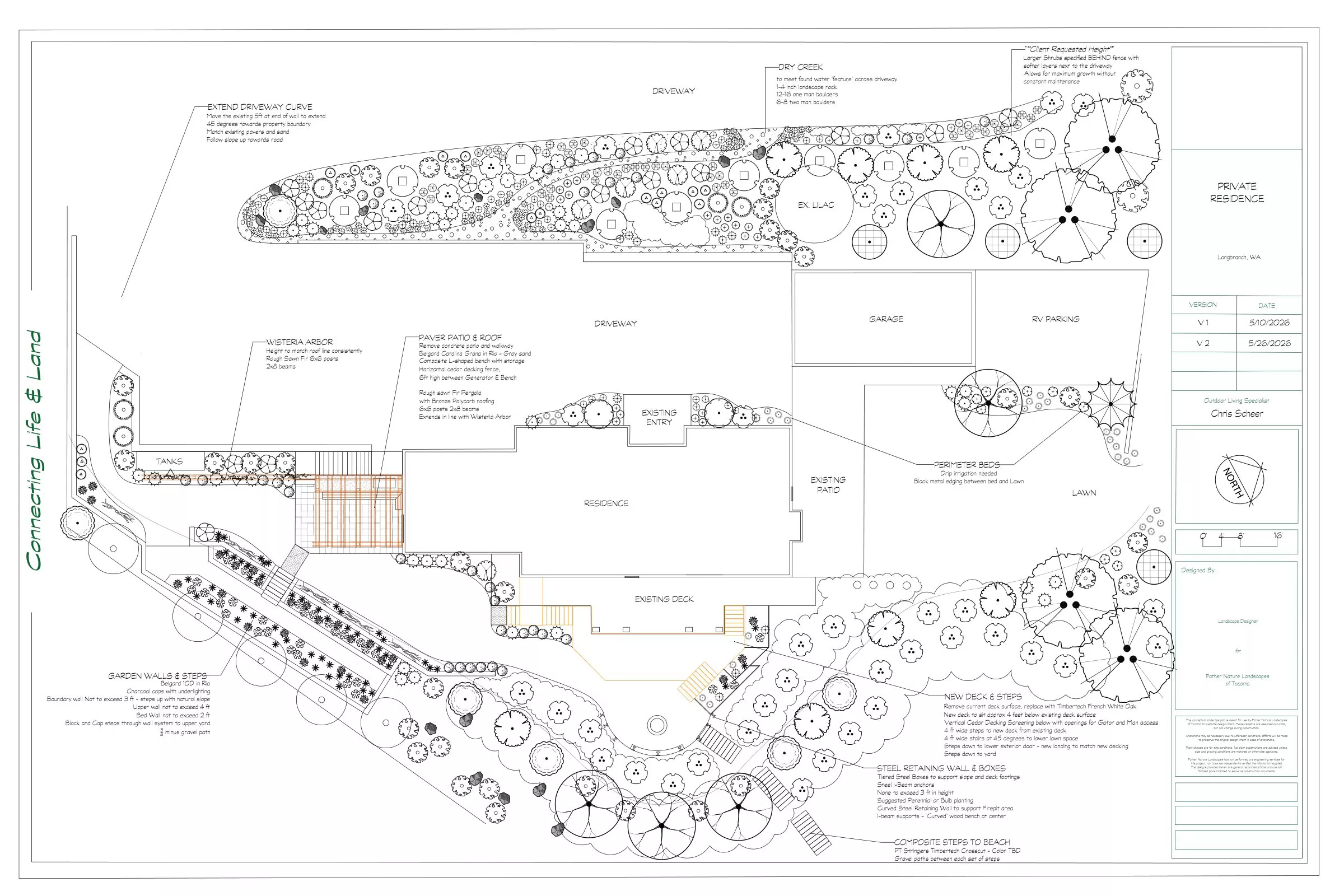
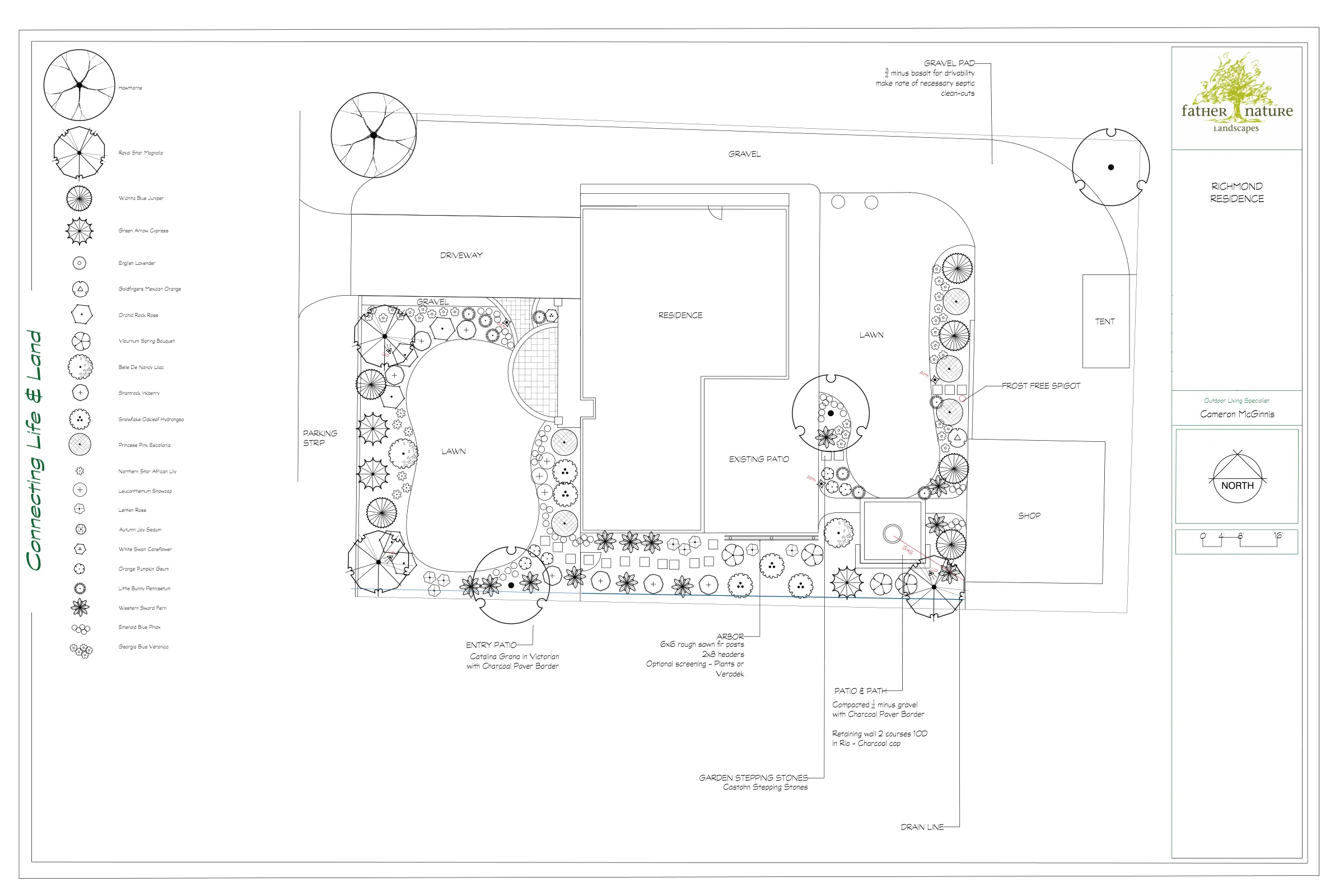
That’s why we start with conceptual landscape design, a scaled plan of the whole yard with the layout, materials, planting, lighting and drainage worked out at the same time. Cameron McGinnis, my co-owner, or I lead the design with you, so the covered patio you want to use in February and the water under it get solved in one proper design instead of two separate jobs. Our guide to backyard renovation in Tacoma walks through how the whole project comes together.
The Bottom Line
Every drainage fix does one job, and the right mix for your yard depends on where the water comes from, what’s under the lawn and what you want to build on top. Choose them inside the plan for the whole yard and they hold. Choose them one puddle at a time and the water tends to move next door. Even a yard that’s been soggy every winter can carry the outdoor space you’re picturing, once the water has somewhere to go.
And yes, we build in the rain. We prefer to build when it’s raining. The wet season shows us exactly what the water does on your site, and we do the work while you’re inside, so your outdoor space could be ready by spring or sooner. Conceptual landscape design starts at $2,500, and we work within about 30 miles of our shop on Portland Avenue in Tacoma.
If the same spots are wet again this year and you’re ready to turn the yard you’ve been picturing into the real thing, set up a free site walk. Cameron or I will walk it with you while the water’s still showing.
Frequently Asked Questions
What is the best drainage solution for a Tacoma yard?
There isn’t one. The right fix depends on where the water comes from, what’s under your lawn and what you’re building on top. Many yards need two or three working together, such as downspout lines, a corrected grade along the house and a drain or swale for the low ground.
Will you install just a French drain?
Not on its own. If one drain is all your yard needs, a drainage specialist is the better call, and I’m happy to point you to one. We build drainage as part of a renovation, where it’s designed with the patio, the planting and everything else.
Can drainage be installed in the winter?
Yes, and it’s often the better time. Wet ground shows exactly where water collects and which way it travels, so the drainage gets built to what your site really does. Our crews work straight through the wet season.
Sources
- NOAA NCEI, U.S. Climate Normals 1991-2020, Annual, Tacoma #1
- NOAA NCEI, U.S. Climate Normals 1991-2020, Monthly, Tacoma #1
- City of Tacoma, MLK Subarea Draft EIS, Earth Chapter (2012)
- USDA NRCS, Alderwood Series Official Series Description
- Chapter 51-51 WAC, Washington State Residential Code
- 2021 International Residential Code, Chapter 4 Foundations
- Washington State Department of Ecology, Rain Garden Handbook for Western Washington (2013)
- City of Tacoma Stormwater Management Manual, July 2026
- City of Tacoma, Stormwater Permits and Manuals