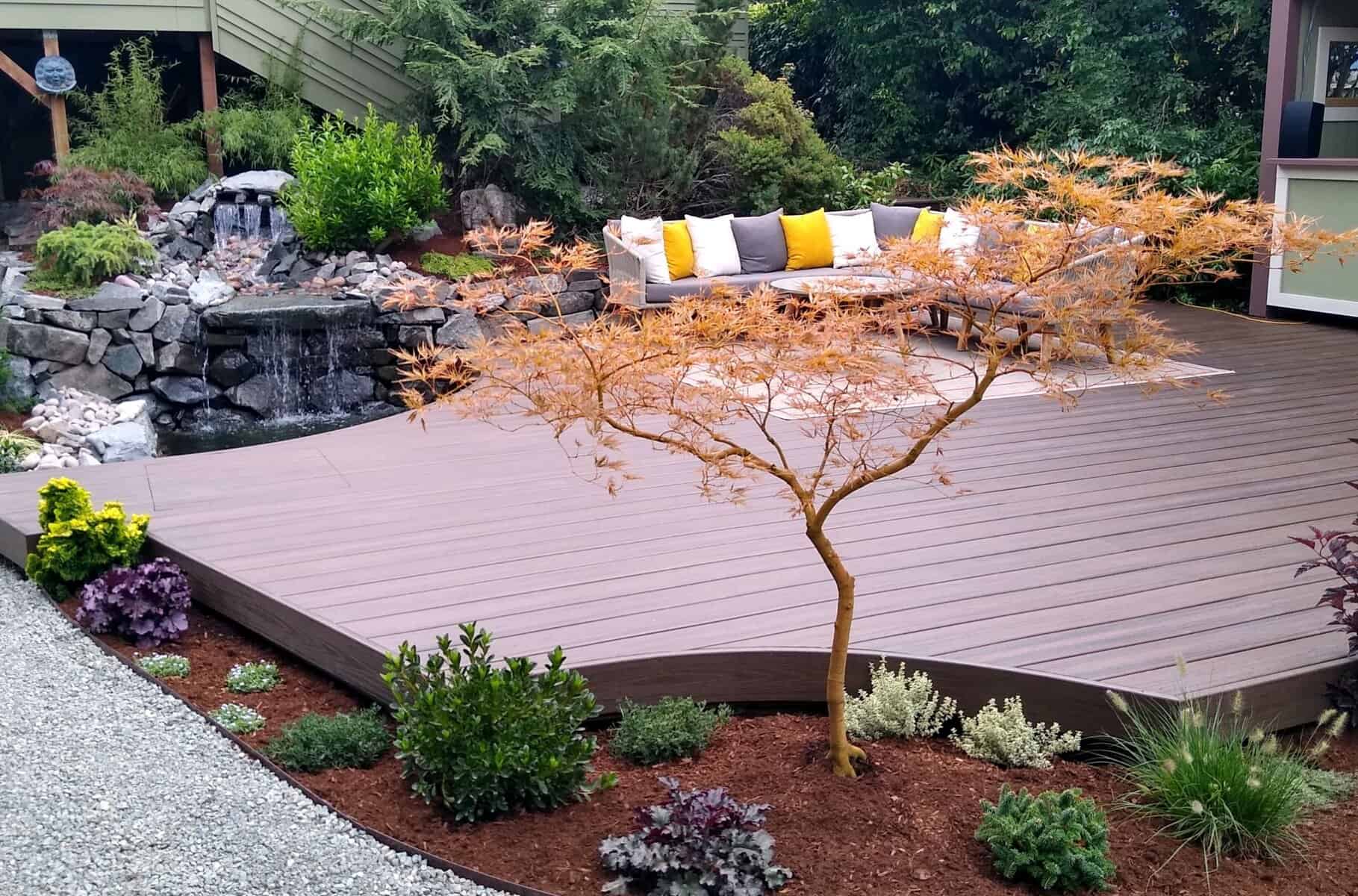
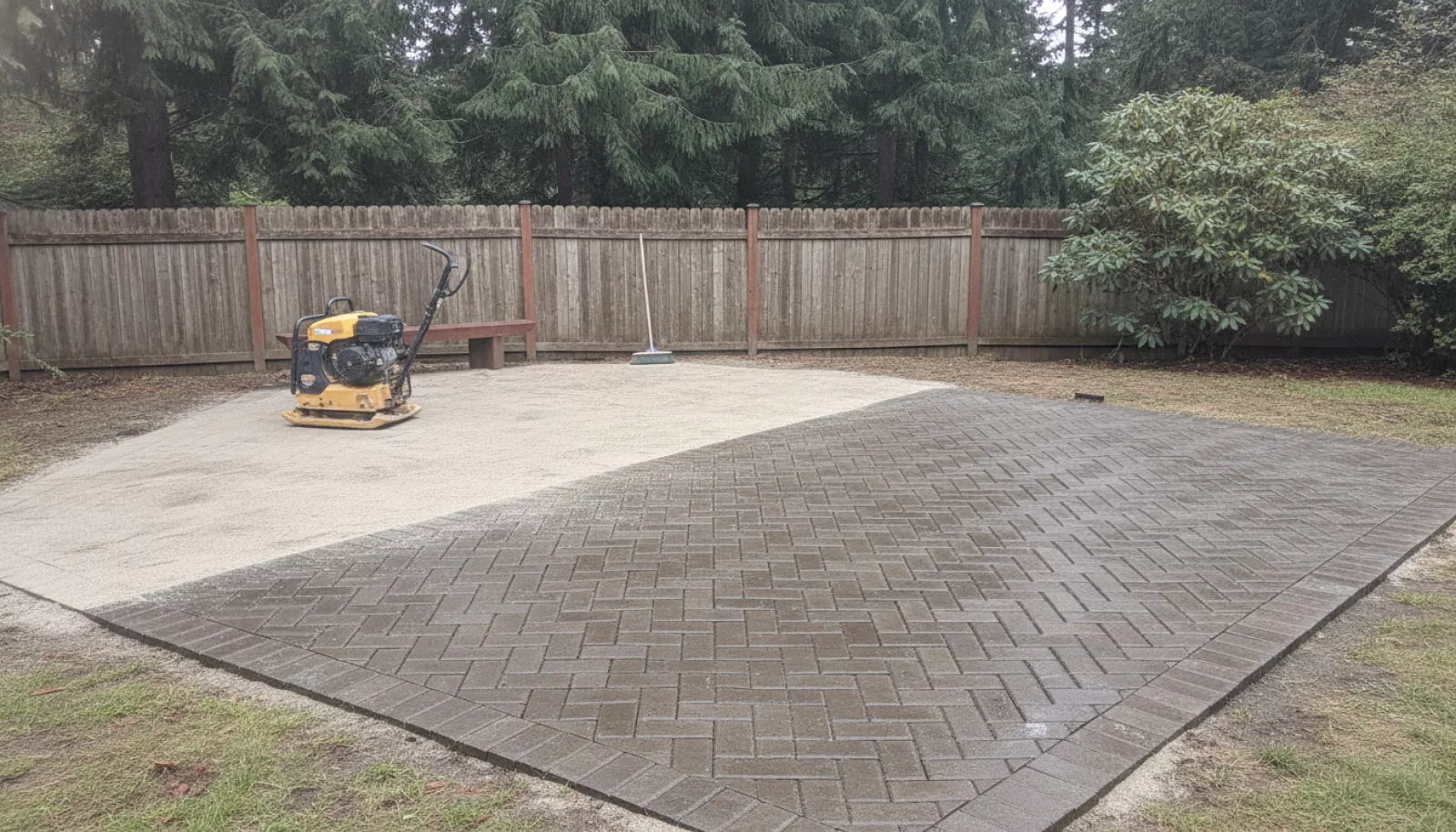
The rain is back, and the same spots in your yard are holding water again. The low corner by the fence has gone soft, there’s water sitting on the patio, and the lawn along the house won’t firm up until spring. If those spots have been patched before and came back anyway, you’re probably wondering whether the whole yard needs rethinking rather than one more fix.
I’ve been building outdoor spaces in Tacoma since 2006, and the first thing I’d tell you about backyard drainage problems is that they’re a diagnosis before they’re a fix. The wet season is when you can read them. And if the yard is going to be redone anyway, the drainage belongs inside that plan, not bolted on after it.
Life+Land Lessons
- About 76 percent of Tacoma’s normal yearly rain falls from October through March, so winter is when a yard shows you what it does with water.
- Tacoma’s Alderwood soils turn very slowly permeable about 3 feet down. Rain soaks in, then backs up.
- Section R401.3 of the 2021 International Residential Code wants the grade to fall at least 6 inches in the first 10 feet from the house. Any plan starts at the foundation.
- In Tacoma, 2,000 square feet of new plus replaced hard surface brings in the city’s stormwater requirements, and patios count.
- A drain aimed at one wet spot often just moves the water somewhere else, so drainage belongs in the design.
Signs of Backyard Drainage Problems, and What Each One Points To
Every one of these is a symptom, and the same symptom can have more than one cause. That’s why I don’t name a fix from the driveway.
| What you see | The usual cause | What that means in a renovation |
|---|---|---|
| Standing water in the yard after the rain stops | A low spot with no way out, or dense soil below that water can’t get through | Whatever goes in that spot sits in water until the grade or the outlet changes |
| A soggy backyard that never firms up all winter | Water perched over a dense layer, often fed by roof water | The plan calls for planting and surfaces chosen for ground that stays wet |
| Water pooling near the foundation | Ground that falls toward the house, or downspouts emptying at the wall | The first thing a plan sets, before any patio height |
| A slope that sheds water or soil onto the patio | Runoff from above that nothing catches | Walls, steps and planting on that slope carry their own drainage |
| Erosion and washed-out beds | Water gathered into one path by a downspout, a hard surface or the slope | Beds won’t hold until the water’s path is designed |
| Puddles on a patio or walk | A surface laid too flat, or sunk below the ground around it | A new surface on the same pitch gives you a newer puddle |
The honest answer to most of these is “it depends on what’s next to it,” which is the whole case for looking at the yard as one piece.
Why Tacoma Yards Hold Water Every Winter
Three things put the water in your yard every winter: when the rain falls, what sits a few feet under the lawn, and what’s been built on top.
NOAA’s Tacoma #1 weather station has a normal of 40.81 inches of rain a year, but the total matters less than the timing. About 76 percent of the total falls from October through March, with November the wettest month at 6.50 inches and July down near half an inch. So the yard takes most of its year’s water in the months when nothing’s drying it out.
Then there’s the ground. The City of Tacoma’s environmental review describes soils within the city as the Alderwood-Everett association, formed in glacial till and glacial outwash. Those two soils behave very differently. Everett soils drain fast. Alderwood soils sit on a weakly cemented, very slowly permeable layer that starts about three feet down, and the USDA’s description of the Alderwood series puts a perched seasonal water table roughly one to three feet below the surface at times from December through April.
In plain terms, the rain soaks through the top layer, hits a layer water can’t get through, and has nowhere to go but sideways or back up. That’s how your yard can hold water while the one down the street drains fine. A citywide description doesn’t tell you what’s under your lot, so I don’t assume anything until I’ve seen it wet.
On top of the ground sits everything that’s been built:
- Roofs and downspouts, which gather rain off a big area and drop all that water in a few spots.
- Patios, driveways and walks that shed water, often straight toward the lawn.
- Grade that tips toward the house, sometimes since the house was built, sometimes from beds raised a little higher every few years.
- Soil packed hard during earlier work, so water runs across the surface instead of soaking in.
Water Pooling Near the Foundation Comes First
Washington adopts the 2021 International Residential Code as its residential building code, and section R401.3 of that code says lots shall be graded to drain surface water away from foundation walls. The grade shall fall not fewer than 6 inches within the first 10 feet. Impervious surfaces within 10 feet of the foundation shall slope at least 2 percent away from the building. Where lot lines, walls or slopes make that much fall impossible, the code calls for drains or swales to carry the water away.
For your yard, that means the ground against the house is the first thing a plan settles. A patio poured tight to the wall and a bed built up against the siding over the years can each quietly turn that slope around. In a renovation we set those heights first, because everything else steps down from them.
One honest limit. If water is coming through a basement wall, that’s a question for a foundation specialist, not a landscape company.
Why a One-Spot Fix Often Moves the Water
Water has to go somewhere, and a fix aimed at one wet spot decides where without looking at the rest of the yard. Often the fix just moves the problem:
- A drain that empties into the next low spot, or toward the neighbor’s yard, so the water turns up at the other end of the lawn.
- A rain garden dug in the soggy low spot. The Department of Ecology’s rain garden handbook for Western Washington says not to put one in low spots that don’t drain well, within 10 feet of a foundation, or where winter groundwater rises within a foot of its bottom. That describes a lot of the wet corners I get asked to look at.
- A patio added a few years later that sends more water at the same problem the drain was put in to solve.
Tacoma has a say too, once the work gets big enough. Under the city’s July 2026 stormwater manual, rooftops, patios, walkways and driveways all count as hard surface, and a project with 2,000 square feet or more of new plus replaced hard surface has to meet the first five of the city’s minimum stormwater requirements. Working on a private drainage system connected to the city’s storm network also needs a city permit. On a whole-yard renovation, add up every patio, walk and roof you’re adding or replacing before assuming that line doesn’t apply.
Our older post on drainage solutions in Tacoma covers how the fixes themselves work, French drains and the rest. I won’t repeat it here, because the fix is the last decision, not the first.
Why Drainage Belongs in the Design, Not After It
In a renovation, the drainage decisions and the layout decisions are the same decisions. A patio’s position, height and pitch decide where the water goes. Here’s what gets worked out together:
- Grade and finished elevations, set before anyone picks a patio height.
- Where the hard surfaces go and which way each one sheds.
- Walls on a slope, which carry their own drainage behind them. Our pieces on retaining walls for sloped yards and how Pacific Northwest slopes behave go deeper on that.
- Planting chosen for ground that stays wet, instead of a lawn that fights the wet every winter.
- One outlet for the whole yard, so every downspout, drain and surface sends water somewhere that can take it.
Drainage rarely starts the conversation. The outdoor space you want does, and one thing leads to the next. Here’s how I’ve put it: “Most people these days are asking for some sort of covering so they can use that patio year-round. […] But to do all that, too, we have to fix their drainage, and then we’re going to put their lawn back, and usually they want plants to go with it.”
That chain is why we start with conceptual landscape design, a scaled plan of the whole yard with the layout, materials, planting, lighting, drainage and flow worked out at the same time. My co-owner, Cameron McGinnis, or I lead the design with you, and our design partner produces the drawings, so the covered patio and its drainage get solved in one proper design instead of two separate jobs.
What We Look at on a Wet-Season Site Walk
The rain is the best time to walk a yard with drainage questions, because the problems are showing. In August a wet corner is just a brown corner, and in November the same corner tells you most of what you need to know. Cameron or I walk the property with you, and the site walk is free.
Here’s what we look at:
- Where the roof water lands, and where it runs next.
- The grade along the house.
- The low spots, and what drains into them from above and from next door.
- The slope above the yard, if there is one.
- Where water could leave the property.
- What you want built on top of all that.
That last one leads the walk. You already know where the water is. What I want to hear is what you’d do out there if water weren’t a problem, a covered patio you’d sit under in February or a fire on a fall evening, and then we look at what the water means for each.
And yes, we build in the rain. As I tell people, “We prefer to build when it’s raining.” The wet season shows us exactly what the water does on your site, so the problem gets fixed in the build instead of guessed at in July. We do the work while you’re inside, so your outdoor space could be ready by spring or sooner.
When the Answer Is Bigger Than Drainage
Here’s the test I’d use. Water, plus a slope, plus a patio nobody uses, plus beds that wash out every winter, is less a drainage problem than a yard asking for a plan. That’s when a full renovation makes sense, and our guide to backyard renovation in Tacoma walks through how one comes together.
If the rest of your yard is finished and you love it, and what you need is one drain in one spot, I don’t think we’d be the right fit for you. A good drainage contractor is, and there are good ones around here who do exactly that work.
For the bigger job, conceptual landscape design starts at $2,500. From the design comes an estimate built from real data, and then our own crew builds the renovation, billed on the actual time on site and the actual materials. Renovations start at $50,000, and we work within about 30 miles of our shop on Portland Avenue in Tacoma.
The Bottom Line
Water in a Tacoma yard comes from the rain, the ground and what’s been built on top, so a fix holds only when chosen after the diagnosis and inside the plan for the whole yard. If the same spots are wet again this year and you’re ready to think about the yard you actually want, set up a free site walk and Cameron or I will walk it with you while the water’s still showing.
Frequently Asked Questions
Can you fix yard drainage in the winter?
Yes, and winter is often the better time. Wet ground shows where water collects and which way it travels, so the drainage gets built to what your site really does instead of a guess made in a dry month. Our crew works straight through the wet season.
Do I need a permit to fix drainage in my yard in Tacoma?
Sometimes. In the city, work on a private drainage system tied into Tacoma’s storm network needs a City of Tacoma permit, and a project with 2,000 square feet or more of new plus replaced hard surface brings in the city’s stormwater requirements. Outside city limits your own jurisdiction’s rules apply, and we sort out which ones fit as part of the design.
Will you install just a French drain?
Not on its own. If one drain is all your yard needs, a drainage specialist is the better call, and I’m happy to point you to one. Our post on drainage solutions in Tacoma explains how French drains work.
Sources
- NOAA NCEI, U.S. Climate Normals 1991-2020, Annual, Tacoma #1
- NOAA NCEI, U.S. Climate Normals 1991-2020, Monthly, Tacoma #1
- City of Tacoma, MLK Subarea Draft EIS, Earth Chapter (2012)
- USDA NRCS, Alderwood Series Official Series Description
- Chapter 51-51 WAC, Washington State Residential Code
- 2021 International Residential Code, Chapter 4 Foundations
- Washington State Department of Ecology, Rain Garden Handbook for Western Washington (2013)
- City of Tacoma Stormwater Management Manual, July 2026
- City of Tacoma, Stormwater Permits and Manuals