You’ve pictured the fire pit for a while now. Maybe you’ve priced a kit, or saved a photo of one, or stood in the backyard on an October evening and figured out roughly where it would go. What you probably haven’t worked out is where it can legally and sensibly sit, and that turns out to be the decision that constrains everything else about the project.
I’ve been building outdoor spaces in Tacoma and around the South Sound since 2006, which makes this year twenty, and most of what a fire pit builder in Tacoma actually does happens before any stone gets set. I’ve walked a lot of yards where the fire feature ended up in the one spot nobody wanted to sit. That almost never happens because someone picked the wrong stone. It happens because the fire got placed before anyone drew the patio, the seating, and the drainage around it.
The rest of this covers the setback distances Tacoma actually enforces, the two separate burn ban systems that can shut a fire down for two unrelated reasons, the four ways fire ends up in a yard on our projects, and how the whole thing gets sequenced so the fire lands where people will use it.
Life+Land Lessons
- A fire feature is part of a room. It gets drawn into the plan with the paving, the seating, the drainage, and the lighting, or it ends up somewhere nobody sits.
- As of August 2026, the Tacoma Fire Department allows a small recreational fire with no permit when the total fuel area stays at three feet or less across and two feet or less in height.
- A contained fire device, which the City of Tacoma describes as a non-combustible fire pit, fire bowl, or chiminea, has to sit at least fifteen feet from any structure. An uncontained campfire-style fire has to sit at least twenty-five feet out. On a city lot, that distance is usually the biggest constraint on the whole design.
- The size limit lands on the fire itself, not on the stonework around it, so a generous masonry surround is fine as long as the burning area stays inside the rule.
- An open fire whose fuel volume goes over three feet across and two feet high needs a Tacoma Fire Department Bonfire Permit, which carries a fee.
- Burn bans come from two different agencies for two different reasons. The Puget Sound Clean Air Agency issues air quality bans and says plainly that it is not responsible for issuing or enforcing fire safety bans, which the fire marshal or local fire department handles.
- We build both gas and wood-burning features, and the two aren’t in the same position under a ban, because the agencies write their ban language around what’s burning. That choice changes how many evenings a year you can actually use the thing.
- Districts outside the City of Tacoma set their own numbers, and they aren’t identical from district to district. The rule that matters is the one for your address.
- We almost always build a fire feature as one piece of a larger outdoor living build rather than as a job on its own.
The Fire Pit Is the Second Decision, Not the First
The order people work in is usually backwards, and it’s an easy mistake to make because the fire is the part you can picture. You see a photo, you like the stone, you start shopping. The trouble is that the material sets the size of the surround, the surround sets how many people can actually sit at it, and the seating sets where the feature can go on the lot once you account for the house, the setbacks, and the wind. Work that chain in the other direction and you’ve committed to a footprint before you know whether it fits anywhere useful.
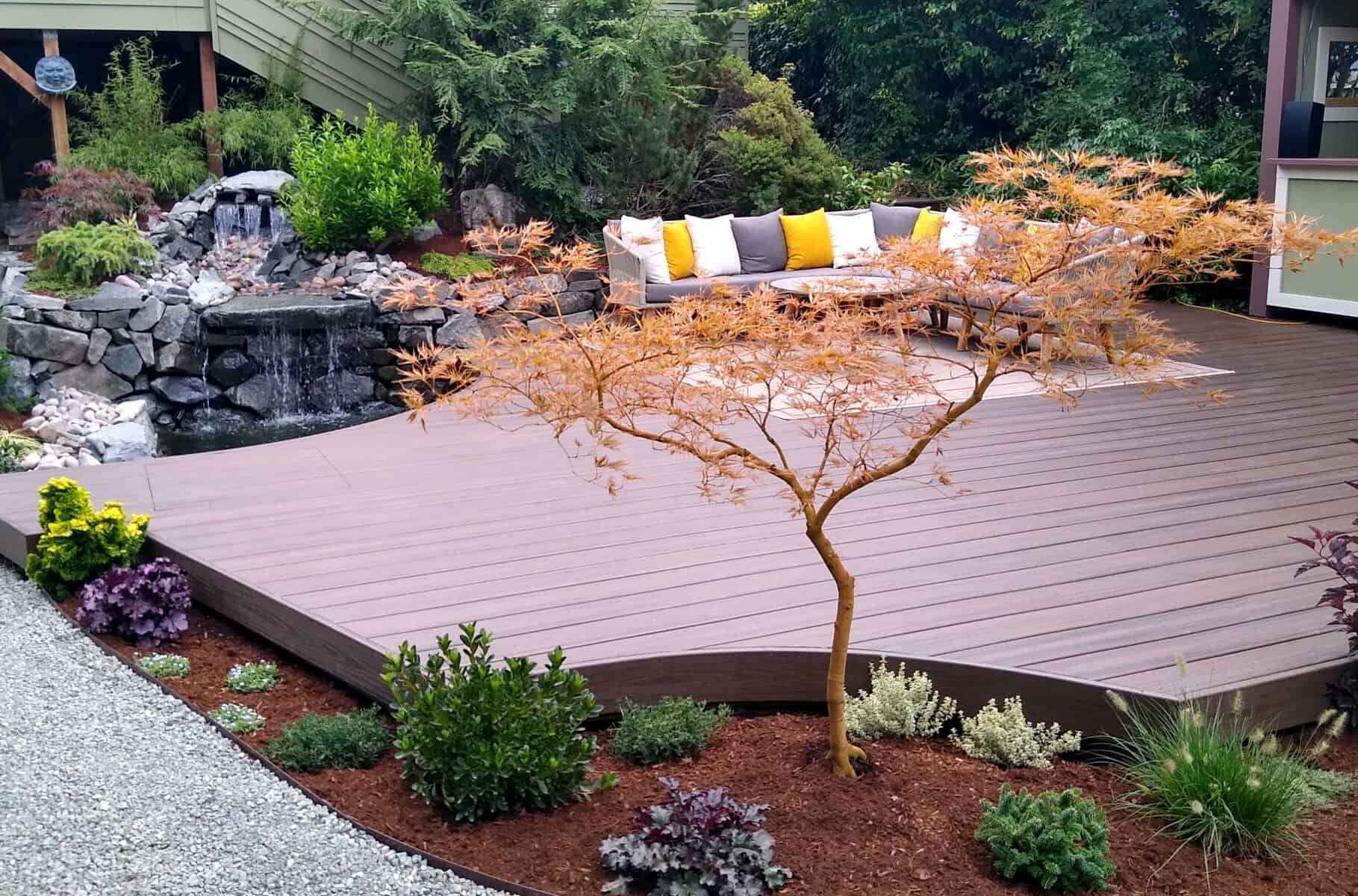
So we match the material of the fire feature to the hardscape around it rather than ordering it out of a catalog. We build fire features in flagstone, in concrete and porcelain pavers, in natural stone, in boulder, and in block, which are the same materials we’re already using for the paving and the walls on that property. When the pit and the patio share a material and a joint pattern, the whole thing reads as one built space. When they don’t, you get an object sitting on a surface, and everyone can tell.
The fuel is part of that same conversation. We build both gas and wood-burning features, and the choice changes what has to be run to the feature and how it behaves when a burn ban is on, so it belongs on the drawing rather than in a decision made the week the crew shows up.
We almost always build a custom fire pit as one piece of a larger outdoor living project. If you’re shopping a standalone pit and nothing else, we’re not the right fit, and I’d rather tell you that on the first call than on the third. There are good masons and good hardscape crews in this area who will do that job well and charge you appropriately for it.
If the fire pit is the first thing you want out of a bigger plan for the yard, that’s a completely different conversation, and it’s the one we’re built for.
Four Ways Fire Ends Up in a Yard
Over the years, fire has landed in four fairly distinct ways on our jobs, and which one fits your property comes out of the site walk rather than a catalog.
The first is a fire pit set into the patio. We lay it out with the paving, so the surround, the joints, and the seating line up instead of meeting at an awkward edge. Our Gray backyard in Tacoma project is the plain version of this, a flagstone patio built around the pit with benches built into the perimeter. Nothing about it is fussy, and that’s the point.
The second is a fire pit with the seating built around it. A seat wall, or a run of low custom seating, is what turns a pit into somewhere people actually stay past the first twenty minutes. The Renton backyard we did is a small lot handled this way, with low seating wrapping an open-air pit that reads as sculpture when nothing is burning. On a tight lot that dual purpose matters, because the feature has to earn its footprint whether or not anything is lit.
The third is an outdoor fireplace. A vertical fireplace does something a pit can’t. It throws heat in one direction, it blocks wind, and it gives a seating area a wall to sit against, which changes how people use the space more than most homeowners expect. The Arrowhead Drive project in Gig Harbor has a fireplace seating area alongside the fire pit and the outdoor kitchen.
The fourth is fire under cover, with heat. On Puget Sound the shoulder seasons are long and wet, and putting a fire inside a covered, heated structure adds months to the year instead of weekends. That’s the combination people start asking about once they’ve spent a full fall watching an uncovered patio go unused.
All four get built in either fuel. We do gas features and wood-burning features, and the choice runs deeper than the flame. A gas feature needs a line run to it, so the trench and the route get drawn with the paving rather than cut in after the patio is set. A wood-burning feature needs somewhere dry to keep wood, which on a Pacific Northwest lot is a real part of the plan. The two also sit differently when a burn ban is on, which is worth understanding before you pick one.
The Setback Is a Design Decision
Here’s where the paper part earns its money. As of August 2026, the Tacoma Fire Department requires a contained fire device, which the city describes as a non-combustible fire pit, fire bowl, or chiminea, to sit at least fifteen feet from any structure. An uncontained campfire-style fire has to sit at least twenty-five feet from any structure.
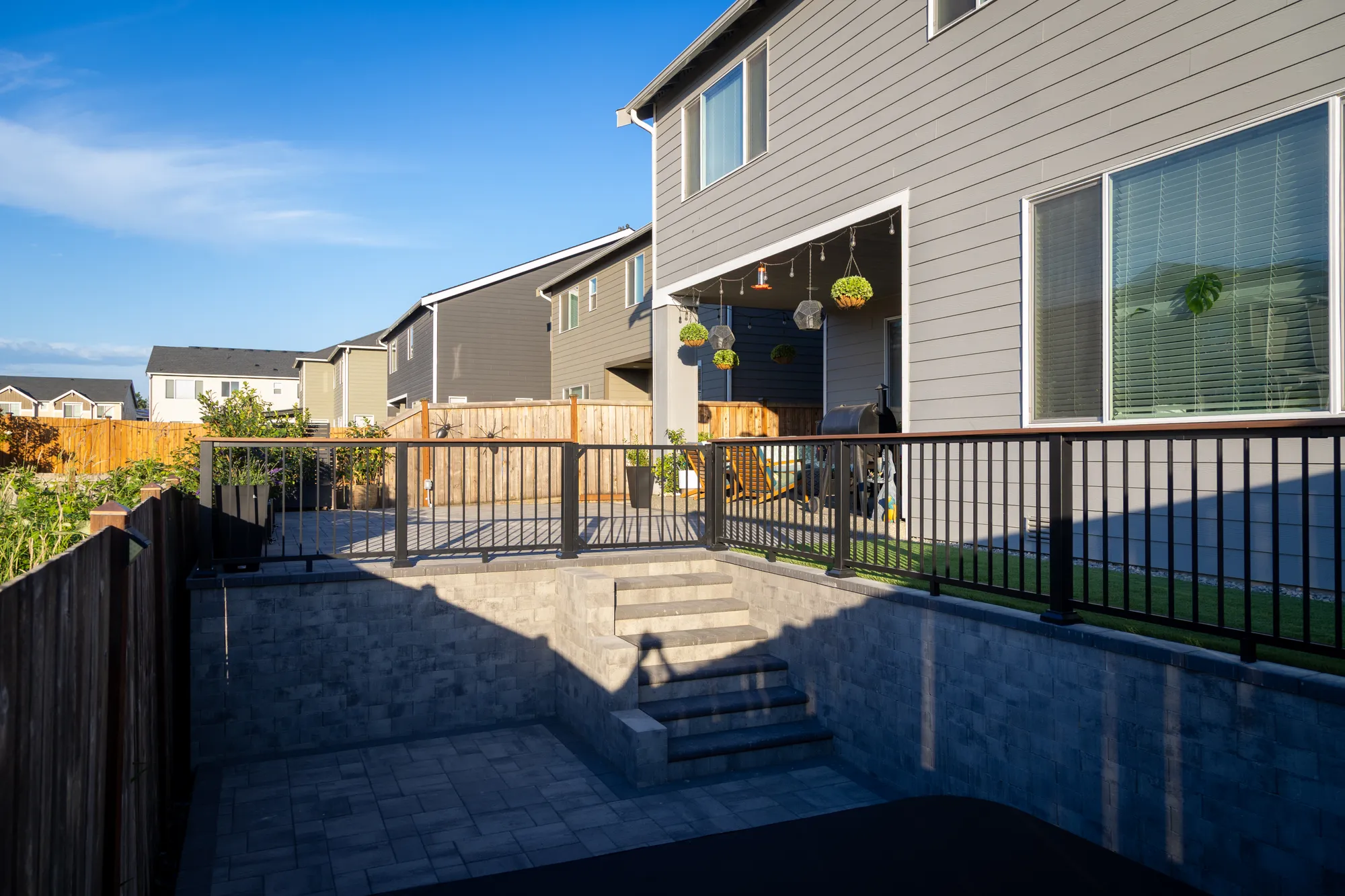
Fifteen feet is a long way on a city lot. Pace it out from your back wall and see where you land. On a lot of Tacoma properties that distance puts you into the middle of the lawn, or against the fence, or in the corner where the ground falls away and the water collects every winter. That’s a reason to solve the geometry on paper, where moving something fifteen feet costs a redraw, rather than after the base is compacted, where it costs a rebuild.
The other thing worth knowing is where the size limit actually lands. Tacoma allows a small recreational fire with no permit when the total fuel area stays at three feet or less across and two feet or less in height. That rule governs the fire, not the stonework around it, so a generous masonry surround, a wide cap you can set a glass on, and a seat wall that wraps two thirds of the circle are all fine as long as the burning area itself stays inside the city’s numbers. A good share of the fire features you’ve admired in photos are mostly surround.
If the fuel volume goes over three feet across and two feet high, you’re into a Tacoma Fire Department Bonfire Permit, which carries a fee. Tacoma also requires an adult to attend the fire at all times, and requires either a fire extinguisher rated 4-A or greater or a charged hose with a nozzle to be readily available, which is worth knowing before you build somewhere with no hose bib within reach.
Burn Bans Come From Two Agencies, for Two Different Reasons
This part confuses almost everyone, and it’s simpler than it looks once you see the structure. The Puget Sound Clean Air Agency issues and enforces air quality burn bans, which go on when air pollution rises to unhealthy levels. In the agency’s own words, these “typically occur during colder fall and winter months.” Fire safety burn bans are a separate thing, issued and enforced by the fire marshal or the local fire department when dry weather raises the wildfire risk. The agency says those “are generally called during the summer and can last for several months, even into the fall,” and it states plainly that it is not responsible for issuing or enforcing them.
Because they answer to two unrelated problems, either ban can be on while the other is off, which is the part that catches people. During a clean air agency burn ban, all outdoor burning is prohibited, and the agency specifically names “wood- and charcoal-fueled recreational fires.” Tacoma’s own page says small recreational fires are not allowed while a Tacoma Fire Department fire safety burn ban or a Puget Sound Clean Air Agency burn ban is in effect.
Since we build both fuels, here’s the honest version of what that means for the choice. The clean air agency’s concern is wood smoke and fine particles, and its ban language names wood- and charcoal-fueled recreational fires. Tacoma says plainly that propane and natural gas barbecues can generally be used during a burn ban while charcoal, wood, and other solid-fuel ones can’t, and it lists propane among the permissible fuels for a contained fire device where it doesn’t for an open campfire-style fire. What Tacoma doesn’t publish is an explicit carve-out for a gas fire pit during a ban, so I’m not going to tell you that you can light one. What I will tell you is that a gas feature and a wood-burning one aren’t in the same position when a ban is on, that the difference is worth real evenings over a year, and that it’s a reason to settle the fuel during design rather than after.
Last caveat, and it’s a real one. Everything above is the City of Tacoma as of August 2026. Districts outside the city set their own numbers and they aren’t identical from district to district, so the rule that matters for your project is the one written for your address. We confirm that during design.
What a Fire Feature Pairs With
Fire rarely shows up alone on our jobs, because the things around it are what make it usable.
Paving comes first, since the fire and the patio get laid out together and the hardscape installation sets the base, the drainage, and the joint lines the feature has to meet. Outdoor kitchens are the next most common pairing, and how the cooking side and the sitting side relate to each other is worth thinking about early. Our longer read on outdoor kitchen layout covers that. Decks come into it when the grade calls for one, and we build those in composite or thermally modified wood on our custom deck projects.
Cover and shade are what turn a fire from a summer feature into a most-of-the-year feature, and our piece on patio covers and shade structures walks through the options. The pergolas, covered structures, and kitchen carpentry all run through our outdoor construction crew. Lighting is the piece people forget and then notice immediately, because a fire lights the two feet around it and nothing else, so the path to the house and the steps down to the lawn need their own light. The Fircrest project is a good example of the full set working together, with a paver patio, retaining walls, a firepit, an outdoor kitchen, a patio cover, a water feature, lighting, and synthetic turf.
Site Walk, Plan, Build
The process is three steps and there’s nothing clever about it.
It starts with a free site walk. Cameron McGinnis or I come out, walk the property with you, and look at where a fire could actually go given the house, the setbacks, the wind, and how you use the yard now. We’re both deciding whether this is a fit, and either of us can say it isn’t, which is the whole point of the visit.
Then comes the plan. Conceptual landscape design starts at $2,500, and it’s a scaled, buildable drawing covering the fire feature and everything it touches: layout, materials, seating, paving, drainage, lighting, and a clear cost estimate we walk through with you line by line at the kitchen table. Cameron McGinnis and I lead the design ourselves, and our design partner produces the drawings. The walk itself costs you nothing, the design and the build do, and I’d rather draw that line clearly than have you find it later.
Then we build. Our own crew handles the groundwork, the base, the structure, and the finish work, on a schedule we confirm before the contract. At the end we do a walkthrough and hand you a care guide covering what to do, what not to do, and what to expect after the first Pacific Northwest winter.
On billing, we give you an initial estimate, and once the work starts we bill time and materials. You pay for the hours and the materials the job actually takes rather than a padded guess at both. That means the estimate is an estimate, and I won’t tell you it’s a locked number, because on custom stonework in ground nobody has opened yet, it isn’t.
The Honest Fit
We’re not the right builder for everyone, and it saves us both time to say so here.
If you want a fire pit and nothing else, we’re not it. If you’re comparing bids and the lowest number is the one that decides it, we’re not it either, because we won’t be that number and I’d rather you know that before you spend an evening on a proposal. If you’re planning to do the base work yourself and hire out the stone, that’s a fine plan and it isn’t ours.
Who we’re right for is the homeowner who has been thinking about the backyard for years, intends to stay in the house, and wants the whole thing worked out once by people they won’t have to chase. Here’s how one of those projects read from the client’s side.
“We used Father Nature to do a complete overhaul of our yard: design, take down of existing trees, patio, fire pit, the works. They were flat out amazing. Our yard looks fantastic and two of our neighbors already want to use them. Cameron and his team were reliable, on time, and worked diligently to complete the project. Father Nature is also trustworthy and dependable, which is hard to find in these days.”
John Canorro, Google review
If you want to know where a fire could actually go on your property, have Cameron McGinnis or me walk the yard with you. The site walk is free. We’ll pace the setbacks, look at the wind and the drainage, and tell you plainly what we think the yard wants.
Frequently Asked Questions
Can I have a fire pit in my backyard in Tacoma?
Generally yes. As of August 2026, the Tacoma Fire Department allows a small recreational fire with no permit as long as the total fuel area stays at three feet or less across and two feet or less in height, with a contained fire device at least fifteen feet from any structure. Fires are off during a Tacoma Fire Department fire safety burn ban or a Puget Sound Clean Air Agency burn ban. Districts outside the City of Tacoma set their own numbers, so confirm the rule for your own address.
How far does a fire pit have to be from the house?
In Tacoma, as of August 2026, fifteen feet for a contained fire device and twenty-five feet for an uncontained campfire-style fire. On a city lot that distance is often the single biggest constraint on where a feature can go, which is exactly why it gets settled during design rather than during the build.
Will you build just a fire pit?
Rarely, and only inside a project that’s already underway. A standalone pit isn’t the work we’re set up for, and I’d rather say that early than take a job neither of us ends up happy with. If the fire pit is the first piece of a bigger plan for the yard, that’s a different and better conversation.
What does a fire feature cost?
It depends on the material, the size, the seating, and whether it ties into paving, a wall, a kitchen, or a cover. The number comes out of the site walk and the design, because we don’t give estimates off the hip.
Can we use it in the winter?
That’s usually the point. Fire, cover, and heat together are what keep a yard in use from October through April around here. Air quality burn bans do land in the colder months, and this is where the fuel choice shows up in real life, because a wood-burning feature and a gas one aren’t in the same position under a ban. The clean air agency writes its ban language around wood- and charcoal-fueled fires, and Tacoma says propane and natural gas barbecues can generally be used during a ban while solid-fuel ones can’t. Tacoma doesn’t publish an explicit carve-out for a gas fire pit, so check the current ban language before you light anything. The covered, heated part of the space works either way.
Do you handle permits?
A recreational fire that size doesn’t need a permit in Tacoma. The patio, the wall, the structure, or the utility work around it can, and we manage the permitting a project needs.
About the Author
Chris Scheer is Co-owner and Outdoor Living Specialist at Father Nature Landscapes of Tacoma, which he has co-owned since 2006. He leads design and runs the build and maintenance crews within about 30 miles of the shop on Portland Avenue East, including Tacoma, Gig Harbor, Puyallup, University Place, Lakewood, and Fox Island. Father Nature holds Washington contractor license FATHENL922JT and has earned more than 200 five-star reviews across Google, Yelp, and Angie’s List. Cameron McGinnis is also Co-owner and Outdoor Living Specialist, and one of them handles the first site walk on every project personally.