If you’re holding two proposals that don’t line up, one from a firm that designs and builds and one from a designer whose plan you’d take to a separate installer, start by counting the contracts. With design-build, one firm answers for the plan and the build. When you hire a designer and a contractor separately, you sign two contracts, with a handoff in between that neither one fully owns. Most of the design-build vs. hiring separately question comes down to that one difference.
For a whole-yard renovation, where walls, drainage, patio, lighting and planting all depend on each other, I’d choose design-build. I’d make an exception for a homeowner who already has a designer they trust and the time to manage the work.
I’ve been building landscapes across Tacoma and the South Sound since 2006. Below are the four places the two models split, when hiring separately is the better call, Washington checks that apply either way, and how we run design and build at Father Nature.
Life+Land Lessons
- Design-build means one contract for design and build together; hiring separately means one for each.
- Accountability slips most easily at the handoff between a designer’s plan and a builder’s crew.
- When one firm designs and prices the work, the plan answers to the same firm that has to build it for a number.
- Hire separately and you become the project manager, even if nobody says so.
- Hiring separately makes sense when you have a designer you love who stays involved, you want competing bids on one plan, and you have time to manage the job.
- Washington’s contractor checks apply either way. Every contractor must register with L&I, and L&I lets you look any of them up before you sign.
How Design-Build and Hiring Separately Actually Work
The trade group for this model, the Design-Build Institute of America (DBIA), says “the single contract for both design and construction is the fundamental difference between design-build and other project delivery systems.” In every other method, DBIA says, “there are separate contracts for design and construction.”
In a residential landscape, design-build means you hire one firm. That firm plans the whole property, prices the plan, builds with its own crew and stands behind the result, all under one agreement.
Hiring separately means a designer draws the plan and hands it to you. You take the drawings to contractors for bids, pick one and sign a second contract. Whether the designer stays involved after delivering the plan depends on what you agreed to.
| Design-build | Hiring separately | |
|---|---|---|
| Contracts you sign | One, covering design and build | Two, one with the designer and one with the builder |
| Who answers when the plan can’t be built as drawn | The firm that holds the contract | Whatever each contract says, which may be no one |
| Who keeps the plan and the budget lined up | The firm that designed the plan prices the work | You, between the designer’s plan and the builder’s bid |
| Who runs the crews and the schedule | The firm | The builder runs crews; you coordinate builder and designer |
| Competing bids on the same plan | No | Yes |
| Who you call after the build | The firm | Usually the builder, or the designer if their contract covers it |
1. The Handoff: Who Answers When the Plan Meets the Ground
Design-build and hiring separately split on the day a crew opens the ground. A plan shows the yard from above. Digging shows what’s underneath, like a grade that falls more than anyone measured, clay that holds water all winter, roots running under the old patio and a buried line that isn’t where the drawing put it.
Under the separate model, that’s the moment you might end up in the middle. The designer says build the plan as drawn. The builder says that isn’t possible, at least not for the number in the bid. Both of them may be right.
In Washington, the Attorney General’s office says the state treats construction disputes as “contractual issues best resolved through private legal action.” In plain terms, you get what each contract says, and the gap between two contracts isn’t written into either one. That gap is one way homeowners end up with something that looked nothing like what was promised, often without anyone doing anything they’d call wrong.
With design-build, the question stays inside one firm. When our crew finds something the plan didn’t show, the problem goes back to whoever led the design, Cameron or me. You hear about it as a conversation, with the options laid out and what each one means for the yard and the budget.
If you do hire separately, ask your designer and your builder before you sign who decides when the plan and the ground disagree, and get the answer in writing.
2. One Plan, One Budget, One Firm Answering for Both
A plan drawn by someone who’ll never price the work can outrun your budget without anyone being at fault. The designer draws what you described wanting. The builder prices what the designer drew. If the two don’t meet, you might find out after the design fee is spent, and then you’re choosing between cutting the plan and paying for a redraw.
When the same firm designs and estimates, the plan is led by a firm that will have to build it for that number and live with the result. That doesn’t make the work cheaper. Budget conversations happen while the plan is still on paper, when a change is easiest.
That’s also why we want the whole yard in one plan instead of pieces. When someone asks for just a roof over their patio, I’ve got to get footings in for it. That can mean cutting through the existing patio, and then the cuts need fixing too. It’s a snowball. Built without a plan, the roof looks as though it was just plunked in there instead of being part of a thought-out, designed process.
Plans do change once you’re standing in the space. We bill the actual time and materials, so a change is a conversation about what it does to the budget, not an argument over a fixed number. Elaine U. described that in her Google review:
“Once the work started, we made several changes to the original design. Instead of pushing back or making excuses, they adjusted quickly and made the changes exactly how we wanted them. Even better, everything stayed within our budget.”
I won’t promise every project lands where hers did, but that’s how changes are supposed to go.
3. Who Manages the Crews, the Schedule, and the Calls
Hiring separately makes you the project manager, often without you noticing you signed up for the job. A whole-yard renovation runs on several kinds of work in a set order, from grading and drainage through walls, patio, lighting and planting. Someone has to schedule each one, pass questions between builder and designer, and decide what happens when one piece slips and the next is waiting.
If what you want is someone to handle it all, not a list of contractors to manage, that’s what design-build is for. One firm sequences the work and takes those calls, design partner included. When a job needed the designer back on site, I’ve had our design partner come out on no notice, and I’ve gotten plants sourced right away.
Design-build fits best if you’d rather spend the build deciding what you want than relaying messages. If you enjoy running a project and have hours to spare, hiring separately may suit you fine.
4. Who Answers for It After the Crew Leaves
Accountability doesn’t end at the last invoice. Think about who you’ll call the first wet winter, when a low corner holds water.
When you hire separately, your designer may have finished long ago, and your builder built what the plan said. Under design-build, the firm that planned and built the yard is still the one to call. We offer maintenance to the homeowners we’ve designed or built for, and Carl Scheer, our Maintenance Manager and Technician, runs that care after the build.
Lisa D. wrote this in her Google review:
“Father Nature did a complete re-work of my yard over several years […] They came back whenever needed to address issues, and made changes at no cost when we’d had a misunderstanding about plant choice for one area. Their crew’s prep, installation and clean-up were impeccable every time.”
When Hiring a Designer and a Contractor Separately Makes Sense
For some homeowners, separate is the better call. That’s true if you already have a designer whose work you love and who’ll stay involved through construction. The Association of Professional Landscape Designers lists “project management or oversight” among the things landscape design may include, so ask whether yours offers that and get the answer in the contract.
Separate also wins if you want competing bids on an identical plan. DBIA notes that with the traditional method, “the primary, if not only, factor considered in the competition is price.” If price comparison is what you want most, hiring separately gives you that. A homeowner with the time and the appetite to manage the job may prefer it, too.
Design-build has an honest limit too. There’s no second bid on the same plan, so you’re trusting one firm’s estimate. That’s why who you hire matters as much as the model you pick.
You’ll also see design-build described as faster, with fewer cost overruns, and DBIA makes that case. The study DBIA points to compared 351 U.S. building projects, not backyards, so I wouldn’t lean on that study to choose a landscape firm.
Washington Checks That Apply Either Way
Whichever model you pick, Washington gives you a few checks worth running before you sign.
- State law says “every contractor shall register with the department,” and bidding or working as a contractor without registering is a gross misdemeanor.
- L&I lists landscaping as its own contractor specialty, covering walkways, garden walls, decorative decks, residential sprinklers and water features, among other work.
- L&I’s Verify tool shows whether a contractor has an active registration, safety citations or lawsuits against their bond.
- L&I says contractors must include their registration number on estimates and bid proposals. Ours is FATHENL922JT.
- On a residential job this size, the contractor must give you a signed Notice to Customer before work starts. Read the notice, because it explains liens and your right to withhold part of the contract.
- “Landscape architect” is a licensed title in Washington. “Landscape designer” is a different title, so whoever you hire, ask to see their built work.
How Father Nature Runs Design and Build
At Father Nature, one firm is accountable from design through build, and that includes the drawings, which we don’t do in-house.
Every project starts with a free site walk with Chris or Cameron. We listen to how you want to use the yard, photograph what’s there and talk plainly about whether we’re the right fit.
Next is conceptual landscape design, a scaled, buildable plan of the whole property covering layout, materials, planting, lighting, drainage and how you move through it. Cameron or I lead every design, and our design partner does the drawings under that lead. Design starts at $2,500, and we walk you through the plan at the kitchen table, line by line. I tell homeowners that design is only there because it’s the vehicle to the construction project, and the plan makes sure we have the roadmap.
From the plan we build an estimate, never an off-the-hip number. Once you go ahead, our own crew builds the project on Time & Materials, billed on the actual hours on site and the actual materials. Afterward, our maintenance team takes care of your finished yard if you want us to.
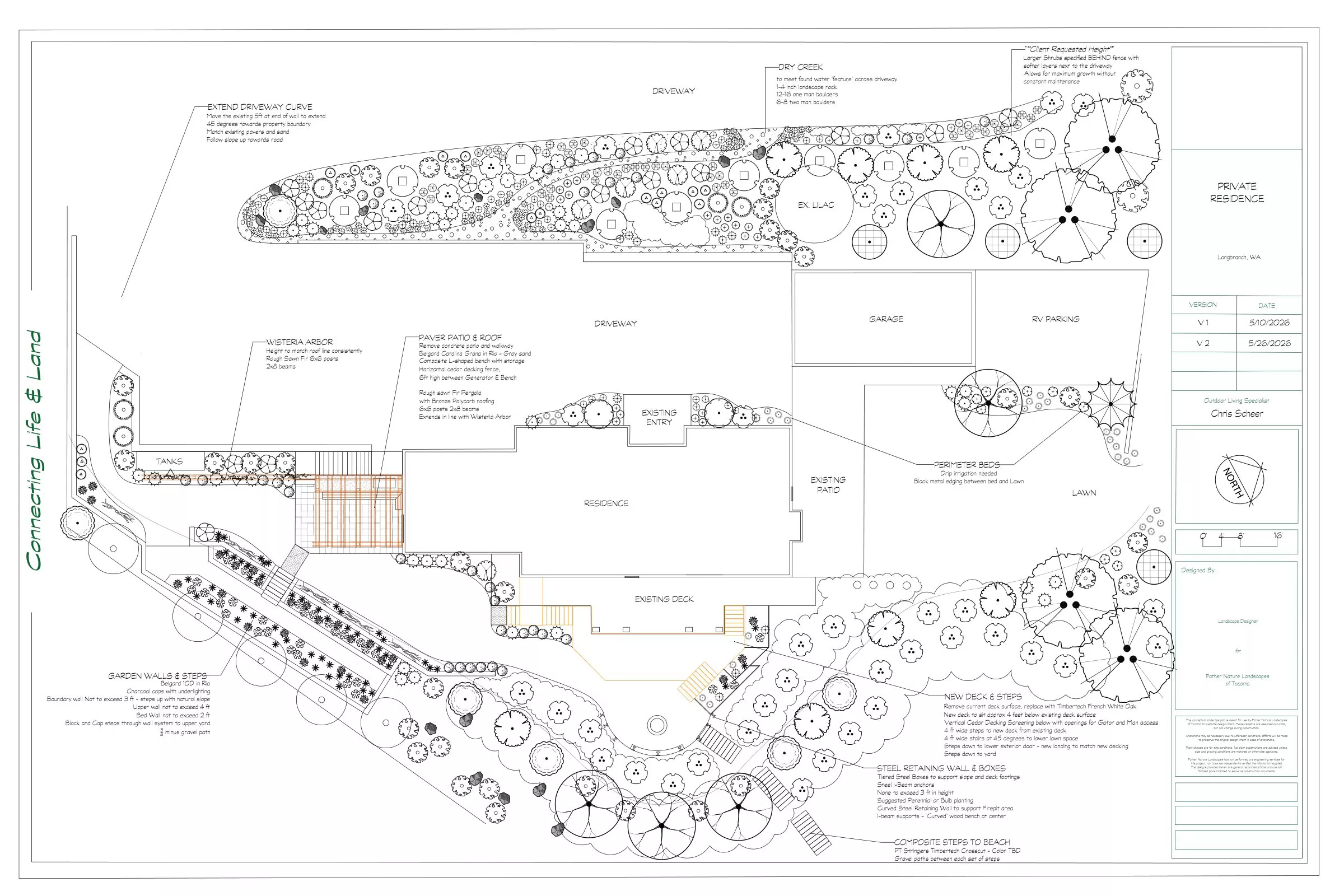
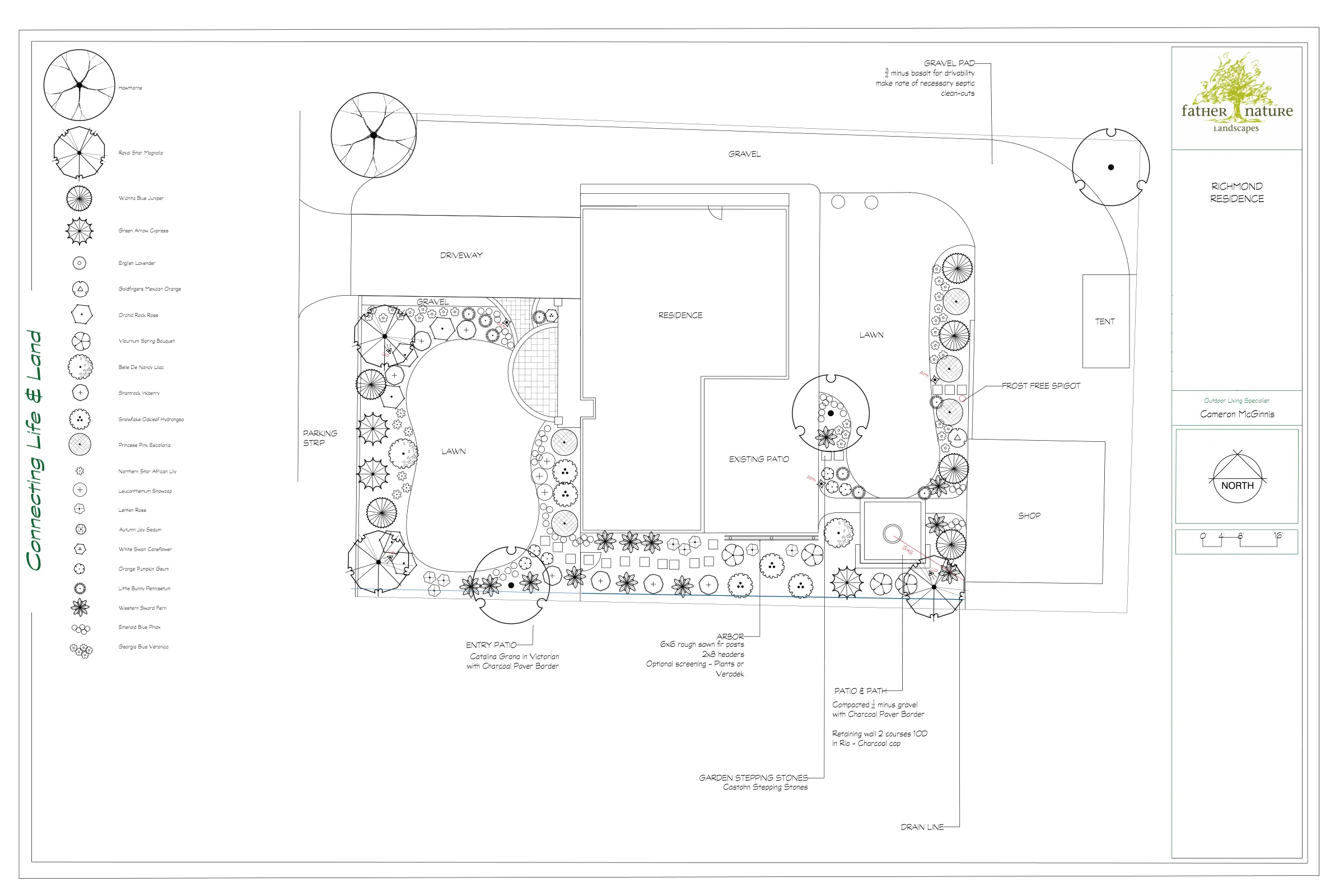
The Richmond Landscape Renovation in Tacoma followed that sequence. Cameron led the design, and the plan he led, the one at the top of this page, drew the whole property to scale, front and back, before our crew built the renovation this year. For the full step-by-step, here’s how a backyard renovation goes from first walk to finished yard.
The Bottom Line
If you’re renovating the whole yard, the work involves several trades, and you want one call to make when something comes up, choose design-build.
Hiring separately serves you well if you have a designer you trust who’ll stay through the build, you want competing bids on one plan, and you have time to manage it.
Need one small piece rather than a renovation? Then we’re not the right fit, and there are local companies that specialize in that work.
Sound like the first case? Book a free site walk with Chris or Cameron. We’ll walk the property with you and tell you plainly what we’d do.
Frequently Asked Questions
Does a design-build firm do its drawings in-house?
That varies by firm, so ask. We don’t. A design partner produces our drawings, under the lead of one of our two co-owners. The firm you contract with is still the one accountable for the plan, the estimate and the build.
Can a landscape designer also build my project?
Yes, if they’re registered as a contractor. Washington requires every contractor to register before bidding on the work. If a designer offers to build too, look them up on L&I’s Verify tool the same way you would any builder.
Is the design fee credited toward the build at Father Nature?
No. The design is its own purchase, and paying for it is how every renovation here starts. You come away with a scaled plan of the whole property, and the build estimate comes from that plan.
How long does design-build take from the first meeting to a signed build?
Longer than most people expect. For two homeowners who said yes to builds this year, it took about two months from the time I met them to the time they said yes. That’s not a fast turnaround, and for a whole-yard renovation it shouldn’t be.